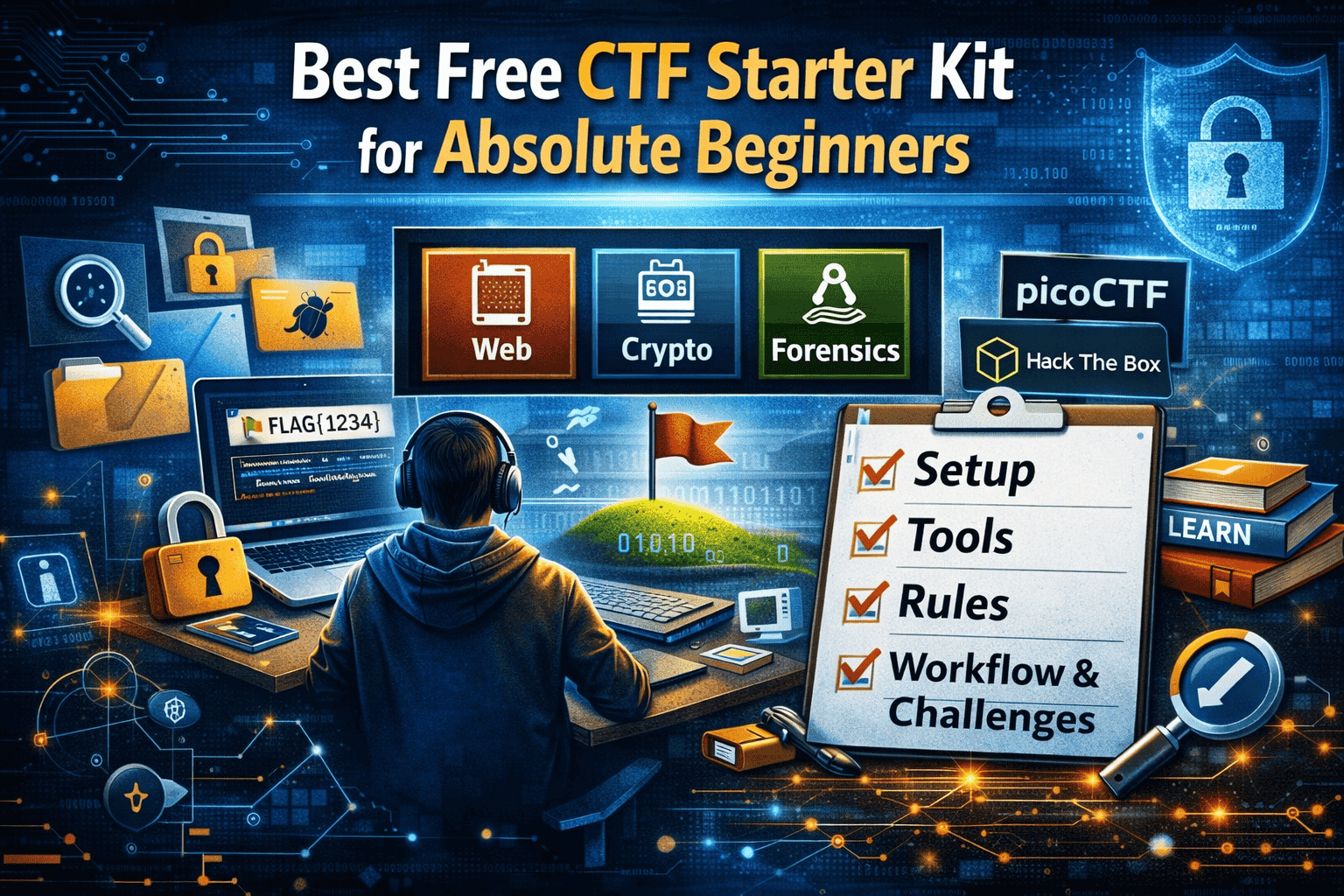
Best Free CTF Starter Kit (2026): Beginner Setup, Tools, Rules & First Challenges
Starting cybersecurity can feel confusing because the internet throws too much at you at once tools, jargon, and advanced topics. The truth is, you don’t need a computer science degree or paid courses to begin. You need a simple plan and a safe way to practice.
That’s where CTF (Capture The Flag) comes in. CTFs are structured cybersecurity challenges that help you learn by solving problems in a legal training environment. You practice skills like reading files, understanding websites, basic cryptography, and simple forensics without touching real targets.
If you’re still deciding where to practice, start with my beginner-friendly guide on the best free CTF platforms for absolute beginners it shows the easiest platforms to begin with and what each one teaches.
What You’ll Have After Reading This
By the end of this starter kit, you will know:
- The simplest beginner setup (Windows/Mac/Linux)
- The minimal tool stack (no overload)
- The legal rules (CTF vs illegal hacking)
- A step-by-step workflow you can reuse for every challenge
- Beginner-friendly challenge types to start solving flags quickly
- A realistic 30-day learning plan
- FAQs (so you don’t get stuck on beginner confusion)
Step 1: 10-Minute Beginner Safety Checklist
Before tools and challenges, set up your learning environment safely. Beginners often practice in the same browser they use for personal accounts, which is messy and risky. This checklist keeps your learning clean and professional.
Do these steps one time:
- Create a separate browser profile for CTF/labs only
- Use dummy passwords for every platform (never reuse your real password)
- Avoid logging into your personal email/social media while practicing labs
- Start a CTF Journal (your notes file) from Day 1
Your journal doesn’t need to be fancy. It just needs to be consistent. Keep a simple format:
- Challenge name + category (Web/Crypto/Linux/Forensics)
- What you tried first
- What worked
- What you learned (1–2 lines)
- Commands/terms to remember
This single habit makes your learning faster than most competitor “tool list” articles because it builds real memory and skill.
Step 2: Beginner Setup (Windows, Mac, Linux)
Many beginner guides push Kali Linux too early. That overwhelms new learners and causes delays. You can solve many beginner CTF challenges with basic built-in tools.
Best free beginner setup (works for most people)
You only need:
- A laptop/PC
- A browser
- A terminal
- A text editor
- A ZIP tool
Windows beginner setup
Windows users can start with:
- Windows Terminal / PowerShell
- 7-Zip (free)
- VS Code (free)
This setup handles most beginner challenges involving files, decoding, logs, and simple web clues.
macOS beginner setup
macOS users can start with:
- Terminal (built-in)
- Unzip (built-in)
- VS Code (free)
macOS is beginner-friendly for CTF because many useful commands already exist.
Linux beginner setup
Linux users already have the ideal environment:
- Terminal
- file utilities
- package manager (for later tools)
At the start, your goal is not installing tools. Your goal is learning how to think and how to observe.
Step 3: The Only Beginner Tools You Actually Need
Beginners often believe “cybersecurity = tools.” In reality, beginner CTF success is mostly about observation and basic skills. This minimal stack prevents overwhelm and still covers everything you need.
If you want a beginner-safe tool list (without overwhelm), I also shared a practical breakdown of the best ethical hacking tools for beginners, including what each tool is used for and when you actually need it.
Essential beginner tools
- Notes / CTF Journal
- You’ll reuse solutions and patterns later. Notes make you faster.
- Terminal
- Used for reading files, searching text, and navigating folders.
- ZIP + file utilities
- Many flags live in archives, text dumps, and log files.
- Browser Developer Tools
- Great for page source clues, hidden fields, and cookie basics.
Optional (Week 2–3): Burp Suite Community for web labs
Burp is powerful for understanding requests, cookies, and sessions. But it’s best introduced after you understand basic web behavior.
Step 4: Legal Rules (CTF vs Illegal Hacking)
This is critical. CTFs are legal because they’re made for training. Real hacking without permission is illegal even if you “don’t mean harm.”
Follow these rules:
- Practice only on CTF platforms and training labs
- Never test random websites, Wi-Fi networks, or accounts
- Don’t run scanners/scripts on targets you don’t own or lack permission to test
- If you’re unsure, stop and choose a legal lab instead
This keeps your learning safe and professional, especially for US and Europe readers where authorization laws are strict.
Step 5: Pick ONE Path for Your First Week
Beginners progress faster when they focus. Don’t try to learn web + crypto + forensics + Linux all at once.
Choose one track for 7 days:
Track A: Confidence track (best for absolute beginners)
You’ll focus on:
- file reading
- simple decoding
- hidden text
- easy forensics
Track B: Web track (best for job-focused learning)
You’ll learn:
- requests/responses
- cookies and sessions
- login behavior
- basic vulnerabilities (concept-first)
Track C: Linux track (best for long-term foundation)
You’ll focus on:
- navigation
- permissions
- searching files
- basic command usage
After week one, you can add a second track.
Step 6: The Beginner CTF Workflow
A workflow makes CTF learning predictable. It reduces panic and builds confidence.
Follow these steps:
- Read the prompt slowly
Look for keywords like “decode,” “metadata,” “cookie,” “source,” “log,” “zip.” - Identify the category
Web? Crypto? Forensics? Linux? Choose your first steps accordingly. - Collect free clues first
Open files, check page source, inspect metadata, read hints. - Try the simplest solution before advanced tools
Beginners often overcomplicate easy flags. - Timebox frustration
If stuck after 15–20 minutes, change strategy or use a hint.
This is how you learn efficiently without burnout.
Prefer a step-by-step learning path instead of jumping between random CTF challenges? Use these best free ethical hacking courses and practice CTF alongside them for faster results.
Step 7: Beginner Challenge Types That Give Fast Wins
If you want early momentum, start with challenge types that are easy but meaningful.
Great beginner challenge types include:
- Hidden text inside files
- Base64 / hex decoding
- ZIP extraction puzzles
- Image metadata clues
- Page source and HTML comments
- robots.txt discoveries
- Basic cookie changes (safe labs)
- Searching logs or text dumps
These teach real fundamentals and build pattern recognition.
30-Day Beginner CTF Plan
Week 1: Confidence + fundamentals
- Solve easy puzzles daily
- Focus on file reading and decoding
- Write notes consistently
Week 2: Web basics
- Learn cookies and sessions
- Practice simple web challenges
- Start beginner web labs
Week 3: Forensics + logs
- Learn metadata and file analysis
- Practice searching logs and text dumps
- Improve your observation skills
Week 4: Review + level up
- Redo older challenges faster
- Rewrite your best notes into clean writeups
- Choose your next specialization
Consistency matters more than intensity.
FAQs
Is CTF legal for beginners?
Yes CTFs are legal when you practice on platforms and labs designed for training. Do not test real targets without explicit permission.
Do I need Kali Linux to start CTF?
No. Beginners can start with a browser, terminal, a ZIP tool, and notes. Kali can be added later if needed.
How much time should I practice daily?
Even 30–45 minutes/day is enough if you practice consistently and take notes.
What should I learn first: Linux or Web?
If you are completely new, start with easy general puzzles and basic Linux navigation. If you want job-ready skills faster, add web fundamentals in week 2.
What’s the fastest way to improve in CTF?
Keep a CTF journal, follow a workflow, and focus on one track at a time. Avoid copying writeups without understanding.
About The Author