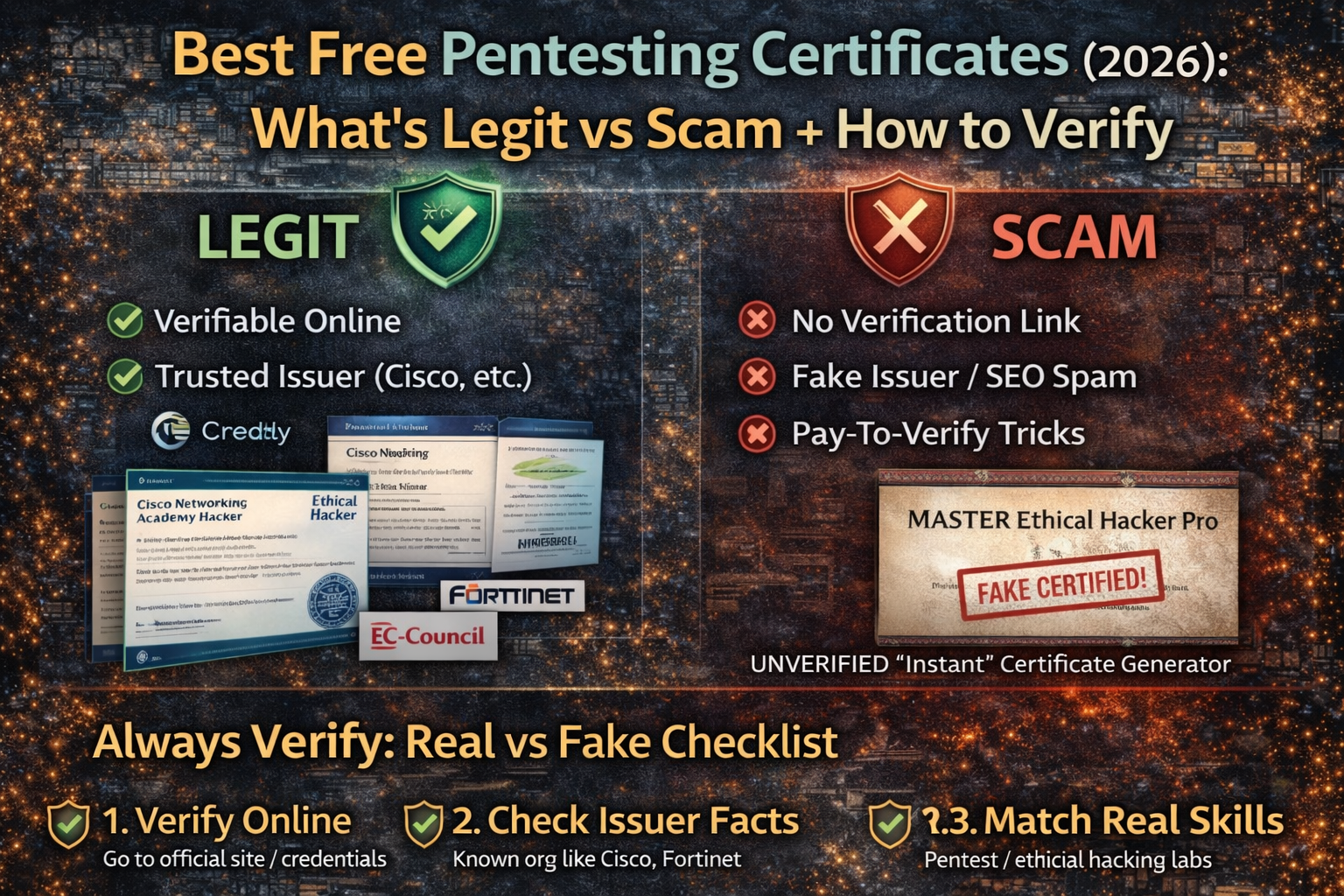
Best Free Pentesting Certificate guide in 2026
When a beginner searches “best free pentesting certificate”, they usually want something simple: a credential that looks real on a CV, boosts LinkedIn, and proves they’re learning ethical hacking the right way. The problem is that the internet is full of “pentesting certificates” that are just downloadable PDFs with no verification and no real value. In pentesting, trust matters. Employers and clients don’t care about fancy-looking paper—they care about verifiable credentials and proof you can practice legally.
This guide explains which “free pentesting certificates” are actually legitimate in 2026, which ones are scams, and how to verify any certificate before you waste time.
What “Free Pentesting Certificate” Really Means in 2026
Most free pentesting certificates fall into one of these categories:
A free certificate might mean you completed a course and earned a completion credential (often a badge). That can still be useful if it’s from a trusted issuer and verifiable. A real pentesting certification usually involves a paid exam, proctoring, or strict assessment. That’s why truly “free” pentesting certifications are rare but free, legit, verifiable pentesting credentials do exist, and they’re good enough for beginners when paired with practice labs.
The best beginner approach is to collect only credentials that are (1) issued by known organizations, (2) verifiable online, and (3) connected to real skills like scoping, testing, and reporting.
Real vs Fake: The Quick Verification Checklist
Before you trust a pentesting certificate, run these checks:
A legit credential usually has a verification method. That might be a badge page, an official certificate link, a unique ID/token, or a credential portal. If you can’t verify it, it’s weak.
A legit credential comes from a known issuer with an official site that explains what the credential is and what you had to do to earn it. Random websites that generate certificates are not trusted.
A legit credential clearly states what you learned or passed. If it only says “Certified Ethical Hacker Pro Master” with no syllabus, no assessment details, and no verification treat it as marketing.
A legit credential doesn’t require you to pay later just to “verify” or “unlock” it. That pay-to-verify pattern is one of the most common scams.
The Best Legit Free Pentesting Certificates (2026)
1) Cisco Certificate in Ethical Hacking (Free path with real steps)
One of the strongest “free” pentesting-style credentials in 2026 is Cisco’s ethical hacking certificate path. Cisco explains the certificate is earned in two steps: first complete the Cisco Networking Academy Ethical Hacker course, then pass at least one Cisco U. Capture the Flag (CTF) challenge. This is important because it’s not an instant PDF it’s a structured process tied to learning and practice.
Cisco also publishes the Ethical Hacker course page in Cisco Networking Academy, describing it as a free online course to build offensive security skills.
For beginners, this is valuable because it looks professional, it’s tied to a trusted global brand, and it teaches real pentesting workflow thinking—scoping, assessment, and reporting.
2) Cisco Networking Academy learning ecosystem (free courses + credibility)
Cisco openly positions Networking Academy as a place to build skills with free self-paced online courses. This matters because even if a specific course certificate is “completion-based,” the issuer credibility is strong and the training is widely recognized.
If you want a beginner-friendly approach to pentesting, vendor-backed learning ecosystems like Cisco are often more trusted than random “certificate websites,” especially when you pair the course completion with practical CTF/lab output.
3) Fortinet free training (good credibility for security fundamentals that support pentesting)
Fortinet states that all self-paced courses are open free of charge, and they run a well-known training and certification ecosystem.
Fortinet’s broader certification program pages explain how they structure certifications and training.
This is not “pure pentesting certification,” but it’s a respected route for building enterprise security fundamentals that directly help pentesters: networking, security controls, and real-world defensive context. A beginner who understands how organizations protect systems usually becomes a stronger pentester later.
4) EC-Council “free” certificate claims: useful for learning, but verify the exact eligibility
EC-Council publishes pages listing free cybersecurity courses and “Essentials” offerings (often targeted toward specific groups like educators or requiring registration).
These can be useful if you qualify and the credential is issued in a verifiable way, but always confirm the exact terms on the official page and avoid third-party sites that repackage the offer.
A lot of beginners get tricked because they think “paid” automatically means “scam” and “free” automatically means “legit.” That’s not how it works.
For example, PortSwigger’s Burp Suite Certified Practitioner is not free, but it’s a great example of what a real verification system looks like. PortSwigger states that successful candidates receive a certificate link with a unique certification identifier, and the certificate shows validity dates.
They also provide an official verification page where a unique certification token can be validated.
You don’t need to buy this as a beginner. But understanding this “verification style” helps you spot fake certificates instantly.
The Most Common “Free Pentesting Certificate” Scams
If you see any of these patterns, avoid them:
A website promises you’ll become a pentester in a day and gives a “certificate” instantly with no structured learning or assessment.
The certificate has no verification link, no credential ID, and no issuer reputation.
The site says “free certificate,” but then charges money to download, validate, or “activate” it.
The certificate uses extreme titles like “Master Hacker Certified” with no clear syllabus and no real-world skills listed.
The site pushes risky downloads or illegal hacking claims as part of the “certificate.” Real pentesting training focuses on legal practice and reporting, not illegal actions.
How to Verify a Pentesting Certificate Before Adding It to Your CV
If you want a safe method that works for any certificate, use this process:
First, search the issuer’s official site and find the program page. If the issuer doesn’t have an official page explaining the credential, don’t trust it.
Second, look for verification proof: a badge page, certificate link with an ID, or a token-based verification portal. PortSwigger explicitly describes this style for its certification, which is a strong example of a real verification system.
Third, confirm the credential actually matches pentesting skills: scoping, vulnerability assessment, web security fundamentals, reporting, and mitigation recommendations. Cisco’s ethical hacking certificate program specifically describes the learning outcome and steps tied to assessments and CTF practice.
The Best Free “Pentesting Credential Stack” for Beginners
A beginner-friendly stack that looks credible without paid tools is:
Start with Cisco’s ethical hacking path and complete the two-step certificate process (course + CTF).
Then build a small set of proof-of-work writeups based on legal labs you complete (web security labs, CTF reflections, or reporting practice).
Finally, strengthen your fundamentals with vendor-backed free training like Fortinet’s self-paced courses so your profile looks balanced and serious.
This combination works because it shows you’re not chasing certificates you’re building skills and outputs.
About The Author