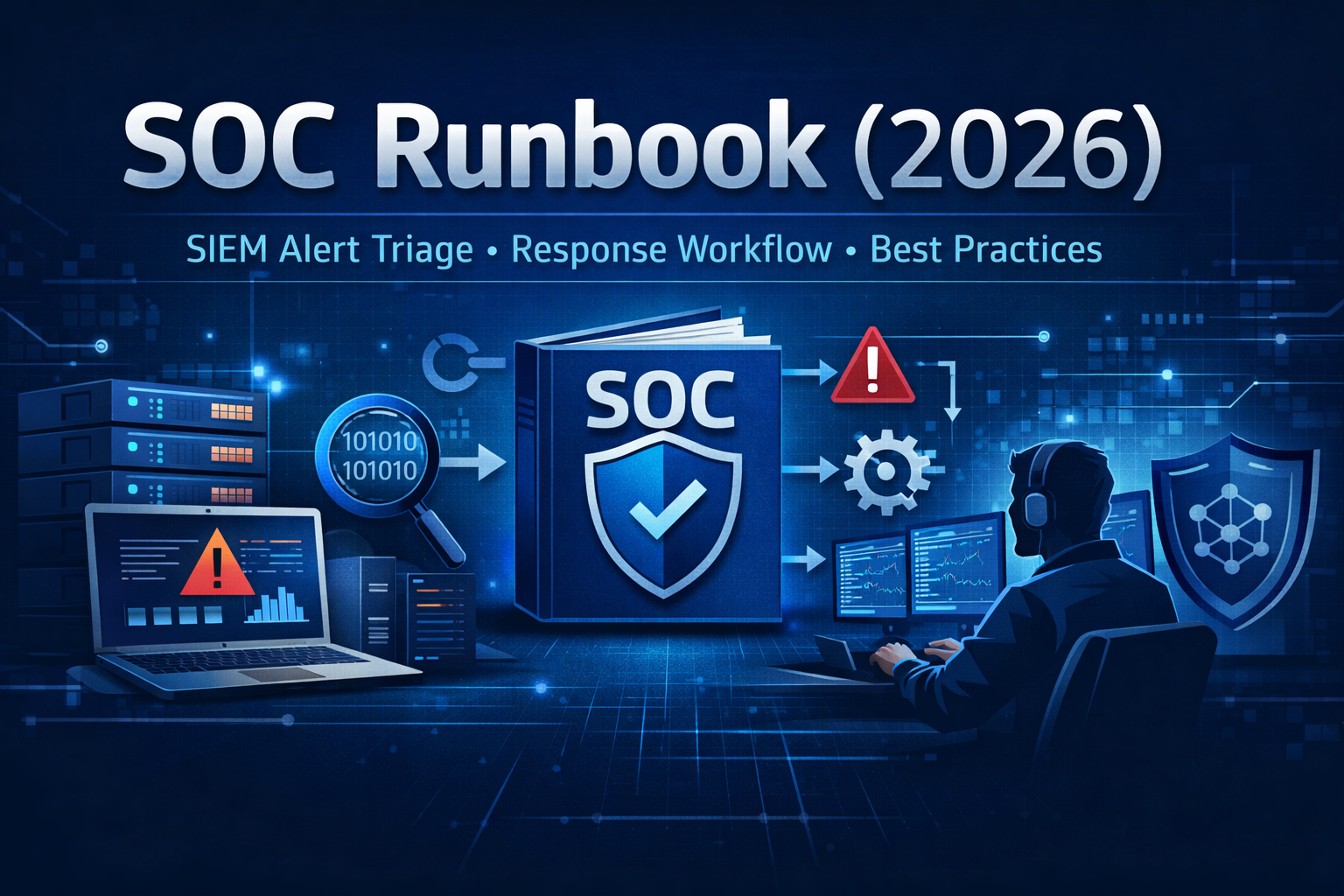
Introduction: Why a SOC Runbook Is Your Best Security “Multiplier” in 2026
In 2026, security teams don’t lose because they lack tools. They lose because they lack speed, consistency, and clarity under pressure. Most organizations already have a SIEM, log sources, maybe even an EDR and a few cloud security tools. Yet incidents still drag on for hours, the same alerts keep repeating, and analysts burn out doing the same manual steps again and again.
A SOC runbook fixes that. It turns “tribal knowledge” into a clear, repeatable process. It helps juniors respond like seniors, makes your monitoring program measurable, and reduces the time between detect → contain → recover. The best part is you don’t need a giant enterprise SOC to benefit from it. Even a small team (or a solo security owner) can run a runbook-driven workflow and look professional.
What Is a SOC Runbook?
A SOC runbook is a documented, step-by-step response procedure for security alerts and incidents. It tells your team:
- What the alert means
- What evidence to collect first
- How to validate (true vs false positive)
- What containment actions to take
- How to escalate and communicate
- What to document for lessons learned
Think of it like a pilot checklist. Even expert pilots use checklists because under stress, memory fails. Security is the same.
Runbook vs Playbook
- Runbook: operational steps for a specific alert type (what to check, where, how, in what order).
- Playbook: broader incident handling strategy (e.g., “Ransomware response”) with phases and roles.
In your blog cluster, your Ransomware Incident Response (2026) post is a playbook; this SOC runbook supports the detection and execution layer.
The SOC Triage Workflow
A high-functioning SOC follows a consistent triage sequence. If you do this same flow every time, you’ll get faster, reduce mistakes, and build reliable metrics.
Step 1: Normalize the Alert
Before you panic, translate the alert into a simple sentence:
- What happened? (e.g., “Multiple failed logins followed by a success on an admin account.”)
- Who is affected? (user, host, cloud workload, website, API key)
- Where did it happen? (endpoint, server, cloud, WordPress admin)
- When did it start? (first seen, last seen)
- What’s the likely objective? (access, persistence, data theft, disruption)
This takes 30 seconds and immediately improves clarity.
Step 2: Set a Severity Score
Avoid random “high/medium/low” guessing. Use a simple severity model that combines Impact + Confidence.
Severity = Impact × Confidence
- Impact: What could this damage if real? (data loss, financial loss, downtime, privilege escalation)
- Confidence: How sure are we this is malicious? (quality of evidence, repetition, correlation)
Quick Severity Table
| Level | Impact | Confidence | Example |
|---|---|---|---|
| P1 Critical | Very high | High | Ransom note + encryption behavior + lateral movement |
| P2 High | High | Medium–High | Admin login from impossible location + unusual API calls |
| P3 Medium | Medium | Medium | Malware detection on one endpoint with unclear spread |
| P4 Low | Low | Medium | Single failed login on normal user |
| P5 Informational | Low | Low | Benign scan noise, expected admin activity |
Step 3: Triage in “Evidence Order”
A mature SOC collects evidence in a standard order:
- Identity evidence (who, auth logs, MFA, role, privilege)
- Endpoint/server evidence (processes, persistence, file changes)
- Network evidence (outbound connections, DNS, C2 patterns)
- Cloud/SaaS evidence (IAM events, API calls, key usage)
- Application evidence (web logs, WordPress admin actions, WAF events)
This order is practical because identity compromise often explains everything else.
Step 4: Decide: True Positive, Benign, or Needs More Data
Use three outcomes to prevent endless analysis:
- True positive: start containment + incident workflow
- Benign: close with clear reasoning and tuning notes
- Needs more data: assign a specific next action (don’t “investigate later” with no plan)
Step 5: Contain First, Investigate Second
If the alert indicates active compromise (admin takeover, ransomware behavior, confirmed malware), containment is priority. You can investigate deeper after stopping damage.
Your SOC Runbook Template
Use this exact structure for every alert type:
Runbook Name:
Alert Source: (SIEM/EDR/WAF/Cloud)
Category: (Auth, Malware, Web attack, Data exfiltration, Cloud IAM)
Severity Guide: (P1–P5)
Primary Signals: (what triggers it)
Common False Positives:
Evidence to Collect (5–10 min)
Validation Steps:
Containment Actions:
Eradication/Recovery Notes:
Escalation Criteria:
Internal Communication:
External Communication
Documentation Required:
Tuning Opportunities:
This format is exactly how competitor SOC content stays actionable and “sticky.”
High-Value SIEM Signals You Should Monitor in 2026
Many SIEMs fail because they ingest too much and alert on the wrong things. Focus on the highest-signal detections first.
Category A: Identity and Access
- Admin login from new country or impossible travel
- MFA disabled or bypassed
- Privilege escalation (user added to admin group)
- New API key created, or key used from unusual IP
- Multiple failed logins followed by success (brute force)
Category B: Endpoint/Server Behavior
- Suspicious PowerShell or shell execution patterns
- New scheduled tasks / cron jobs
- Unsigned binary execution in sensitive directories
- Credential dumping indicators
- Security tool tampering (EDR disabled)
Category C: Network / Exfiltration
- Large data transfer to unknown domains
- DNS tunneling patterns
- Connections to known bad IPs (if you have threat intel)
- Outbound traffic spikes at unusual hours
Category D: Web/App Layer
- WAF blocks showing SQLi/XSS probing patterns
- New admin user created in WordPress
- Plugin/theme changes outside change window
- Suspicious file uploads in
uploads/ - Unexpected redirects or injected scripts
Runbook 1: Suspicious Admin Login
Why this alert matters
Admin login anomalies are one of the strongest early indicators of compromise. Attackers often start with stolen credentials or session tokens. If they land an admin session, the incident can rapidly become ransomware, data theft, or website defacement.
Evidence to collect
- Username, role, MFA status
- Source IP, ASN, geo location, device/browser fingerprint
- Login timestamp + prior login history (last 7–30 days)
- Recent admin actions (new users, settings changes, plugin installs)
- Any concurrent alerts on the same account
Validation steps
- Confirm if the user is traveling or using VPN legitimately
- Check if login was preceded by failed attempts
- Look for suspicious admin actions immediately after login
Containment actions
- Force password reset + revoke sessions
- Require MFA re-enrollment if suspicious
- Temporarily disable the account if high risk
- Block the source IP at WAF/firewall if clearly malicious
Escalate to incident
Escalate if admin actions occurred, or if there’s evidence of persistence, new accounts, or suspicious plugin installs.
Runbook 2: Brute Force Attack on LogIn
Why it matters
Brute force often looks “noisy,” but successful brute force is catastrophic. In 2026, credential stuffing (reused leaked passwords) is extremely common.
Evidence to collect
- Number of attempts, timeframe, targeted usernames
- Success/failure ratio
- Source IPs (single IP vs distributed botnet)
- Any successful login events for targeted accounts
- WAF/Rate-limit logs
Validation steps
- Confirm if this matches normal failed logins
- Identify whether attempts match known bot patterns
Containment actions
- Rate-limit login endpoints
- Block abusive IP ranges
- Enable CAPTCHA
- Enforce MFA and strong password policies
Tuning notes
If you alert on every failed login, you’ll drown. Alert instead on:
- fail → success pattern
- high-volume failures for admin usernames
- distributed attempts across many usernames
Runbook 3: Web Attack detection
Why it matters
Even if the attack doesn’t succeed, probing indicates your site is on a target list. Early detection helps you harden quickly and prevent future compromise.
Evidence to collect
- Request URLs, parameters, user agents
- WAF action (blocked, challenged, allowed)
- Source IP behavior over time
- Any unusual server errors (500s, DB errors)
- Changes to pages (in case of stored XSS)
Validation steps
- Determine if requests were blocked or allowed
- Review application logs for anomalies after the probe
- Verify no new admin users or content changes occurred
Containment actions
- Tighten WAF rules for repeated probes
- Patch vulnerable plugins/components immediately
- Add additional monitoring for file changes
Internal links (recommended):
- Link to your “SQL Injection Explained (2026)” article
- Link to your “XSS Attacks Explained (2026)” article
- Link to “WordPress Malware Removal (2026)” if compromise is suspected
Runbook 4: Malware Detected on Website or Server
Why it matters
Malware in a web environment often leads to redirects, SEO spam, credential theft, or backdoors for future attacks. If you only remove the visible malware but leave the backdoor, reinfection is likely.
Evidence to collect
- File path, hash, creation time, modified time
- Any recent admin/plugin/theme changes
- Web server access logs around first seen time
- Outbound connections from server
- New cron jobs / scheduled tasks
Containment actions
- Put site into maintenance mode if serving malicious content
- Quarantine infected files (don’t delete instantly—preserve evidence)
- Reset credentials and revoke sessions
- Block suspicious outbound traffic if possible
Recovery
- Restore clean files from trusted sources
- Reinstall plugins/themes cleanly
- Clean database if injected content exists
Internal link: your “WordPress Malware Removal (2026)” guide.
Runbook 5: Ransomware Behavior Detected
Why it matters
Ransomware is time-sensitive. Your response speed directly decides how many systems get encrypted and whether backups are impacted.
Early indicators
- Rapid file modifications and extensions changing
- Mass file renaming
- Security tools reporting encryption-like behavior
- Unusual SMB traffic / lateral movement signals
- Ransom note files created
Containment actions
- Isolate infected hosts from the network
- Disable compromised accounts
- Protect backups (disconnect if needed)
- Stop scheduled tasks that spread encryption
SOC Documentation: What to Record Every Time
The biggest difference between amateur and mature SOC operations is documentation. Not because of bureaucracy—but because it improves speed next time and protects you legally/operationally.
Record:
- Alert ID and time window
- Systems/users involved
- Evidence collected (logs, screenshots, hashes)
- Decision and reasoning (TP/FP/needs more data)
- Actions taken (who, what, when)
- Lessons learned + tuning ideas
SIEM Alert Tuning: How Competitor SOC Blogs Avoid “Alert Fatigue”
Alert fatigue kills SOC performance. High-ranking SOC content usually includes tuning guidance because it’s what practitioners actually need.
Practical tuning rules
- Prefer behavior sequences over single events (fail→success, new admin→data access)
- Alert on privileged accounts more aggressively than normal users
- Reduce noise by allow-listing known good automation (backup IPs, CI/CD, monitoring)
- Apply time windows (e.g., “10 failures in 2 minutes”) rather than “any failure”
- Create separate dashboards for informational vs actionable events
Metrics That Prove Your SOC Is Improving
If you want authority (and better management support), track simple metrics:
- MTTD (Mean Time to Detect)
- MTTR (Mean Time to Respond/Recover)
- True positive rate (TP / total alerts)
- Top 10 recurring alert types (what needs tuning)
- Containment time for critical incidents
FAQs
Do small teams need a SOC runbook?
Yes. Small teams benefit the most because they can’t afford slow investigations or repeated mistakes. A runbook makes response predictable and faster.
What’s the difference between SIEM and SOC?
SIEM is a tool for collecting/correlating logs; SOC is the process and people responding to those signals. A runbook connects the tool to action.
Should I automate these runbooks with SOAR?
Automation helps, but only after your manual process is stable. Start with clean runbooks, then automate the repetitive parts.
Conclusion: Your SOC Runbook Is a Competitive Advantage
In 2026, the organizations that survive incidents aren’t necessarily the ones with the most tools. They’re the ones that respond with discipline. A SOC runbook creates that discipline. It turns alerts into actions, chaos into structure, and individuals into a reliable system.
About The Author