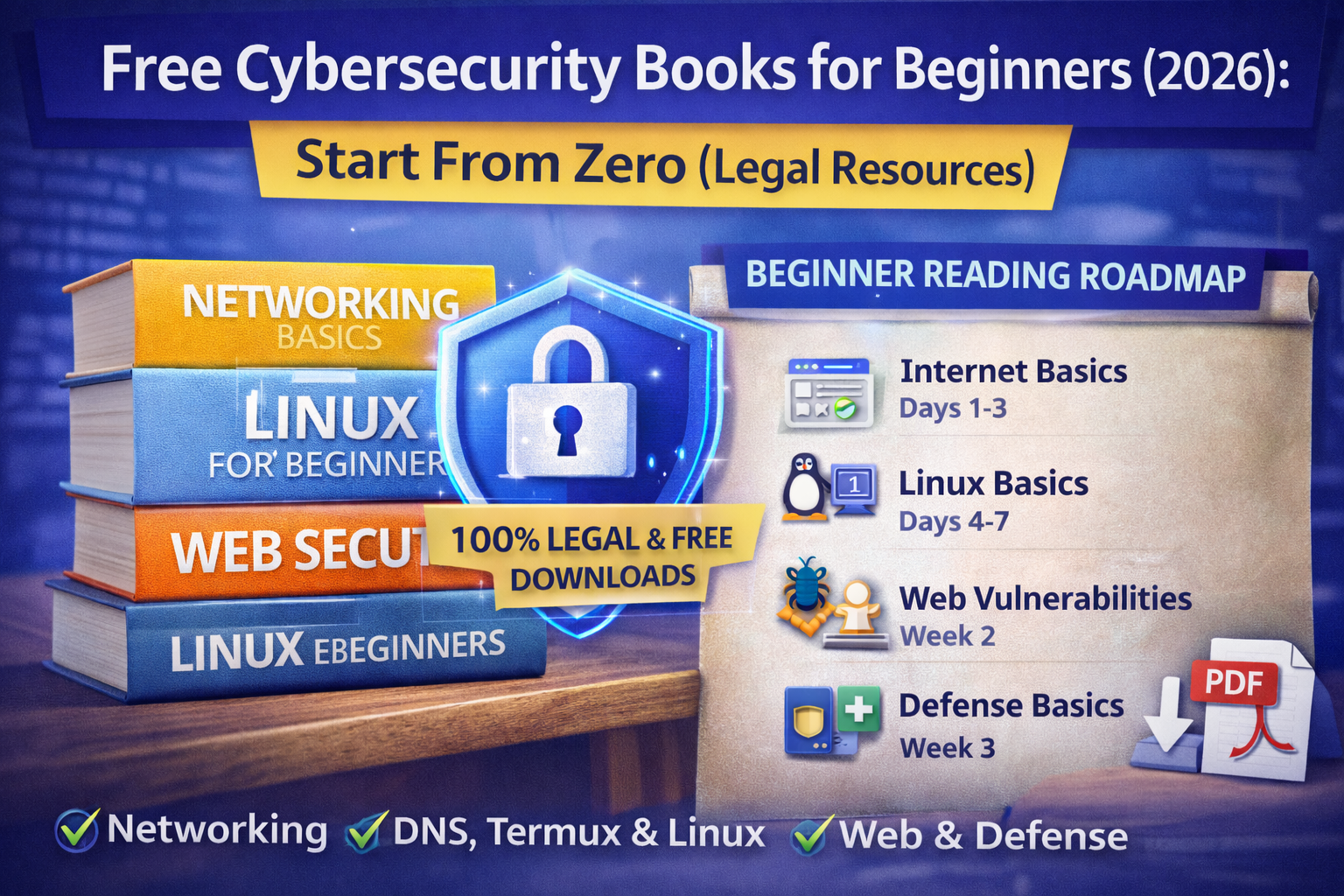
Free Cybersecurity Books for Beginners 2026: Start From Zero
If you’re a beginner, you don’t need “advanced hacking PDFs” to start cybersecurity. You need the basics explained clearly with a learning path that doesn’t waste your time.
Most people search:
- “free cybersecurity books”
- “cybersecurity book for beginners pdf”
- “learn cybersecurity from zero”
…and then end up on shady PDF websites. That’s risky and usually illegal.
The good news: in 2026, there are many high-quality free cybersecurity resources that are 100% legal published by trusted security organizations, official documentation sites, and training platforms. These are often more valuable than random ebooks because they are updated, practical, and safe.
In this guide, you’ll get:
- The best free beginner resources (legal)
- What each one teaches (networking, Linux, web, blue team)
- A simple reading roadmap (what to learn first)
- A practice plan so you don’t just “read”—you actually build skill
What makes a “beginner cybersecurity book” actually useful?
A good beginner resource should:
- explain terms simply (IP, DNS, ports, HTTP, cookies, sessions)
- include real examples (not just theory)
- focus on safe, legal practice
- help you build a foundation you can use later in ethical hacking, bug bounty, or blue team
The best free cybersecurity “books” for beginners (legal resources)
1) NIST Cybersecurity Fundamentals (free, trusted)
Best for: learning cybersecurity like professionals do (risk, controls, incident basics)
NIST publications are widely respected and used in organizations. They’re not flashy, but they teach the fundamentals that real jobs require.
Learn from NIST if you want:
- what cybersecurity really means in real organizations
- why policies and controls matter
- how incident response and risk management work
2) OWASP Cheat Sheet Series (easy, practical, beginner-friendly)
Best for: beginner web security + prevention knowledge
OWASP cheat sheets are like short mini-books you can read quickly and apply instantly.
Great beginner topics:
- authentication and session management
- password storage basics
- input validation basics
- security headers basics
If your audience is common people, OWASP cheat sheets are gold because they answer “what should I do?” fast.
3) OWASP Web Security Testing Guide (WSTG)
Best for: learning web security testing the right way (ethical + structured)
This is more detailed than cheat sheets, but it teaches you a professional testing flow.
Perfect for beginners who want to learn:
- what to check first in a web app
- how vulnerabilities are discovered
- how to document findings
4) PortSwigger Web Security Academy (free “book + labs”)
Best for: learning web vulnerabilities with hands-on practice
Even as a beginner, you can start with basic labs and build up.
Why it’s powerful: it’s not just “read and forget.” It forces you to understand vulnerabilities through practice.
5) OverTheWire (Bandit) – Linux + security mindset
Best for: absolute beginners learning Linux through challenges
This teaches practical command-line skills that help with everything else later.
Why this matters: Most beginners struggle because they skip Linux basics. This makes Linux learning fun and structured.
Beginner reading roadmap (Start from zero in the right order)
Step 1: Learn internet basics first (Day 1–3)
Before any “hacking,” you must understand:
- IP address vs domain name
- DNS (how websites are found)
- ports (80/443/22 etc.)
- HTTP vs HTTPS (encryption)
Goal: You should be able to explain what happens when you type a website in a browser.
Step 2: Learn Linux basics (Day 4–7)
You don’t need to become a Linux expert. You need the basics:
- files and folders
- permissions
- processes
- simple commands (
ls,cd,cat,grep)
Practice tip: Use your Termux article and practice daily on Android.
Step 3: Learn “how attacks really happen” (Week 2)
Now you can learn beginner web concepts:
- phishing basics
- password reuse and credential stuffing
- session hijacking basics
- simple web vulnerabilities (XSS, IDOR, SQLi concept-level)
Best free sources for this stage:
- PortSwigger Academy (start basic)
- OWASP Cheat Sheets
Step 4: Learn defense habits (Week 3)
Beginners should learn defense early because it makes everything safer:
- password manager usage
- 2FA/MFA basics
- backups
- safe browsing habits
- email security basics (phishing awareness)
Link internally to your:
- password manager post
- phishing post
- credential stuffing post
- session hijacking post
Step 5: Learn a simple “security workflow” (Week 4)
This is what separates random learners from real professionals:
Observe → Detect → Verify → Fix → Re-check
Even at home:
- observe your Wi-Fi devices
- verify suspicious activity
- fix router settings
- re-check results
The “No-Piracy” rule
Your readers will search “PDF free download.” You can rank for it without sharing illegal content.
What to recommend instead:
✅ “Read online” official resources
✅ official org publications (OWASP, NIST)
✅ training academies (PortSwigger)
✅ open educational guides (recognized communities)
What to warn about:
❌ random PDF dump sites
❌ Telegram “free book packs”
❌ forced-download pages and installer files
This builds trust and keeps your site clean.
Daily 30 minutes (beginner routine)
- 10 minutes: networking basics (DNS/ports/HTTP)
- 10 minutes: Linux/Termux commands
- 10 minutes: one lab or one cheat sheet
Weekly mini-projects
- Week 1: “Explain how the internet works” (your own notes)
- Week 2: finish 5 PortSwigger beginner labs
- Week 3: create a phishing checklist and apply it to real emails (no clicking)
- Week 4: secure your router (WPA2/WPA3, WPS off, firmware update)
FAQ
Where can beginners learn cybersecurity for free legally?
Use trusted org resources (NIST, OWASP) and hands-on academies like PortSwigger. Avoid pirated PDF sites.
What’s the best free “book” for beginners?
For web security learning, PortSwigger Academy is one of the best because it combines learning + labs. For general fundamentals, OWASP and NIST are excellent.
Should I start with ethical hacking or defensive security?
Start with fundamentals + defensive habits first. It makes you safer and makes ethical hacking easier to understand later.
About The Author