Free Cyber Security Courses (2026): The Best Zero-Cost Training Paths to Learn Cybersecurity From Scratch
Cybersecurity is one of the few fields where you can go from “total beginner” to “job-ready skills” using free training if you follow the right path. The problem is that the internet is full of random playlists and outdated PDFs. A beginner wastes weeks and still can’t answer basic questions like: How do networks work? What is Linux? How do attacks actually happen? How do I practice safely?
So this article gives you a clean, free-only cybersecurity roadmap for 2026, with the best platforms, what each one teaches, and the exact order to learn—like a practical hacker would do it (legally and ethically).
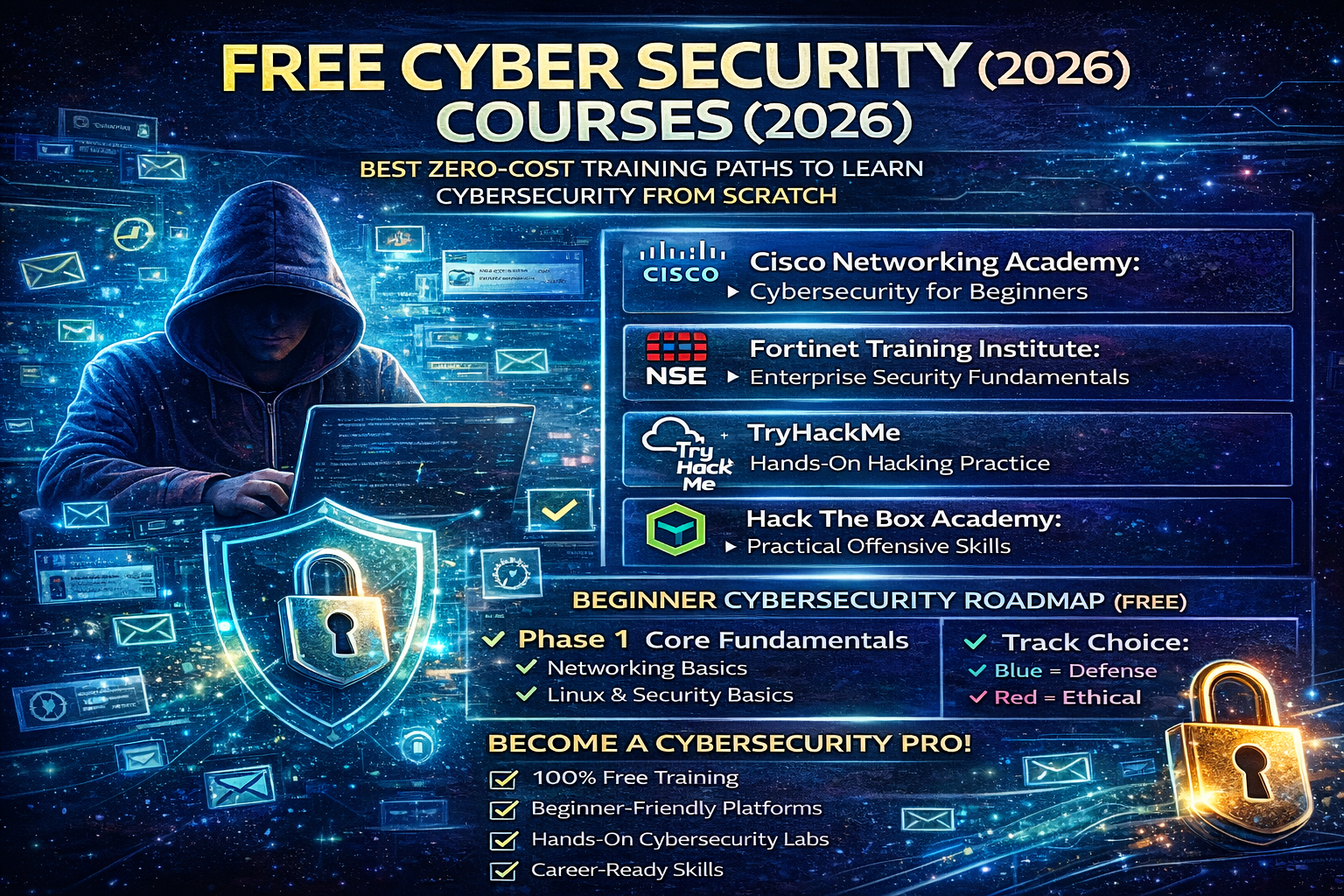
Free Cyber Security Courses in 2026 (Best Picks)
1) Cisco Networking Academy (NetAcad) — Best for absolute beginners
If you want a clean introduction without confusion, start here. Cisco’s free beginner cybersecurity courses teach security concepts in a structured way and are easy to digest.
What you’ll learn
- What cybersecurity is and why attacks happen
- Common threats (phishing, malware, basic attacks)
- How companies protect systems (high-level foundations)
- Early exposure to real security thinking
Best for
- Beginners who need a clear starting point
- Students building fundamentals before hands-on labs
2) Fortinet Training Institute (NSE) — Best free “enterprise security” fundamentals
Fortinet provides free, self-paced cybersecurity training that covers fundamentals through more advanced security topics, built around real-world enterprise security concepts.
What you’ll learn
- Security fundamentals and awareness
- Network security concepts used in real organizations
- Security operations and modern defense themes
Best for
- Learners who want “how companies secure networks”
- People targeting SOC/network security fundamentals
3) TryHackMe Free Tier — Best for guided, beginner-friendly hands-on practice
TryHackMe is one of the easiest ways to start hands-on cybersecurity without breaking anything. It’s designed to teach you step-by-step through browser-based labs and beginner rooms, and it supports a free tier.
What you’ll learn
- Linux basics, networking basics, web fundamentals
- Intro ethical hacking concepts safely
- How to think like an attacker (in a controlled lab)
Best for
- Beginners who learn faster by doing
- Anyone who wants practical skills, not only theory
4) Hack The Box Academy — Best for structured “real hacking skills” progression
Hack The Box Academy offers interactive courses you can start for free and is widely used for practical pentesting skill-building.
What you’ll learn
- Practical offensive security concepts
- Modern web/app and infrastructure security topics
- Skills that translate into real pentesting work
Best for
- Learners who want stronger “hacker-style” depth
- People preparing for pentesting paths long-term
5) Coursera “Free” Cybersecurity Learning Options — Best for course-style learning and audits
Coursera often lists cybersecurity courses that can be started for free (commonly via auditing content or “enroll for free” options depending on the course/program structure). Their cybersecurity catalog is a strong place to find structured learning from major providers.
Best for
- Learners who prefer university-style structure
- People who want more theory + assignments
The Best Free Cybersecurity Learning Path (In the Right Order)
If you want results fast, don’t jump randomly. Follow this order.
Phase 1: Core Fundamentals (Week 1–2)
Your goal is to understand what you’re protecting and how systems talk.
Learn
- Basic cybersecurity concepts (threats, vulnerabilities, risk)
- Networking basics (IP, DNS, HTTP/HTTPS, ports)
- Linux basics (files, permissions, processes)
Free platforms to use
- Cisco NetAcad beginner cybersecurity course
- TryHackMe beginner labs (guided)
Checkpoint (you should be able to explain)
- What is a vulnerability vs exploit vs payload?
- What happens when you open a website (DNS → TCP/HTTPS → HTTP)?
- What is the difference between authentication and authorization?
Phase 2: Hands-On Foundations (Week 2–4)
Now you start learning security by doing—but safely.
Learn
- Linux practice (users, sudo, permissions)
- Networking practice (scanning and enumeration basics conceptually)
- Web basics (requests, cookies, sessions, common mistakes)
Free platforms
- TryHackMe free rooms/path resources
- Hack The Box Academy starter modules
Checkpoint
- You can describe what reconnaissance is and why it matters
- You understand why weak passwords and reused passwords cause takeovers
- You can identify basic web risks like insecure file upload or weak login protection
Phase 3: Defensive Skills (Week 4–6)
To become employable, you need defense knowledge too—how organizations detect and respond.
Learn
- Security monitoring basics (logs, alerts, common signals)
- Incident response fundamentals (containment, eradication, recovery)
- Identity security basics (MFA, session control, phishing defense)
Free platform
- Fortinet free training for enterprise security fundamentals
Checkpoint
- You can explain the difference between malware infection vs credential theft
- You can explain why session hijacking can bypass passwords
- You can explain what a “security baseline” is and why patching matters
Free Cybersecurity Courses by Goal (Choose Your Track)
If you want a job in SOC (Blue Team)
Focus on:
- fundamentals + logs + detection thinking
- incident response basics
- identity and email security
Use:
- Cisco NetAcad (foundation)
- Fortinet training (enterprise fundamentals)
If you want Ethical Hacking / Pentesting (Red Team)
Focus on:
- web fundamentals
- Linux + networking
- hands-on labs and real scenarios
Use:
- TryHackMe (guided labs)
- Hack The Box Academy (deeper modules)
If you want “Cybersecurity for IT / Sysadmin”
Focus on:
- hardening basics
- account security, MFA, patching
- secure configurations and backups
Use:
- Cisco NetAcad (start)
- Fortinet training (security + networking)
How to Pick a “Good” Free Cybersecurity Course (So You Don’t Waste Time)
A free course is worth your time if it has:
- clear outcomes (what you’ll be able to do after)
- updated content and active platform maintenance
- hands-on practice or real-world examples
- structured progression (beginner → intermediate)
Avoid courses that:
- promise “become a hacker in 2 hours”
- focus only on tools without explaining concepts
- encourage illegal activity (that’s not cybersecurity, that’s trouble)
FAQ: Free Cyber Security Courses
Can I learn cybersecurity fully for free?
You can learn a huge amount for free and build real skills using platforms like Cisco NetAcad, Fortinet training, TryHackMe, and Hack The Box Academy.
Certifications and some advanced labs may cost money, but the skills can be built first at zero cost.
What’s the best free platform for beginners?
If you want structured theory first: Cisco NetAcad.
If you want guided hands-on practice: TryHackMe.
About The Author