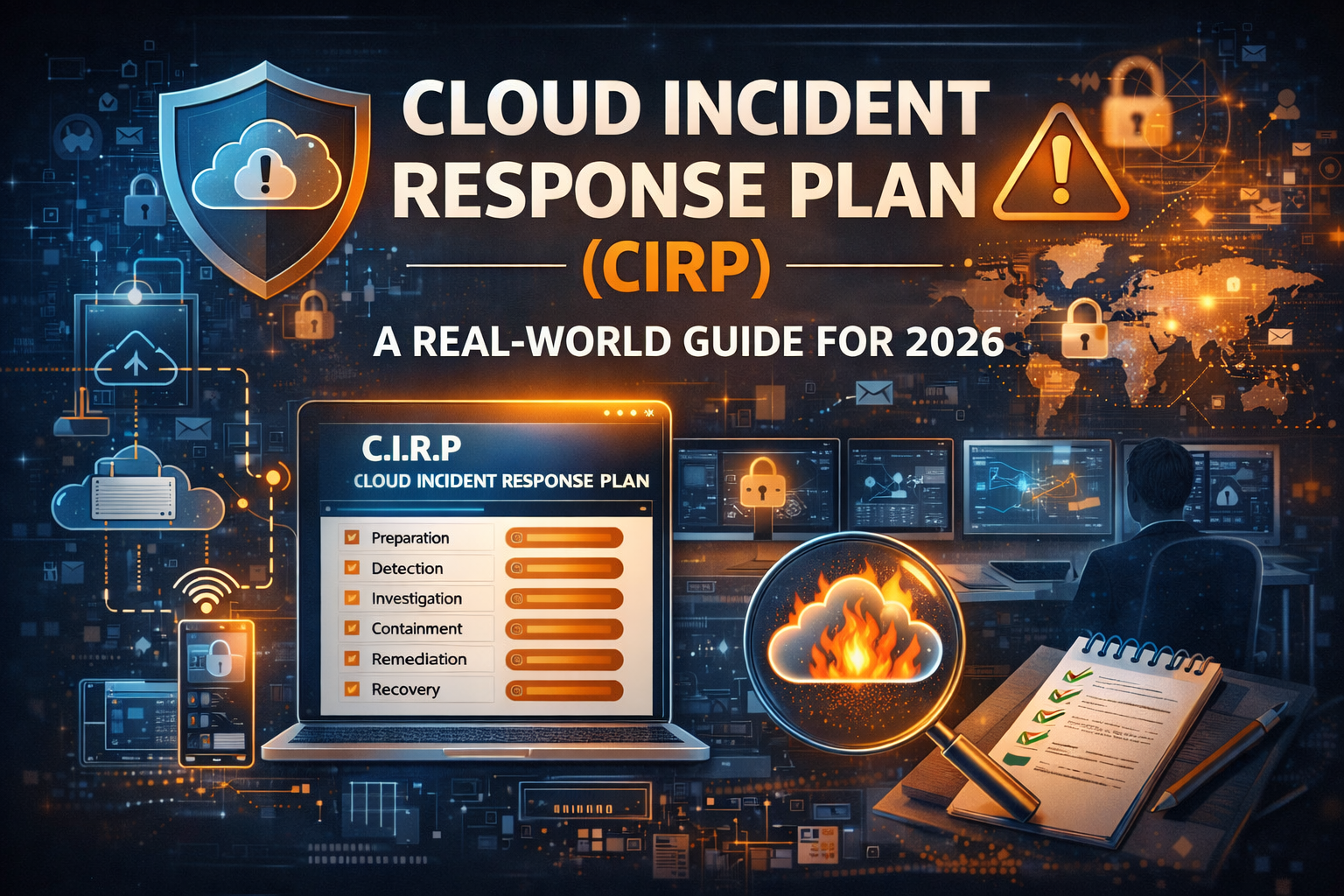
Cloud Incident Response Plan (CIRP): A Real-World Guide for 2026
Introduction: Why every organization needs a cloud incident response plan now?
Over the last decade, organizations quietly moved their most critical business systems into the cloud. Email, file storage, identity management, customer data, financial systems, DevOps pipelines, and internal applications now live inside platforms such as Microsoft 365, AWS, Azure, and Google Cloud.
For many businesses, the cloud is no longer just “part of IT.”
It is the business.
Yet most organizations are still relying on incident response plans that were written for on-premise networks, physical servers, and traditional perimeter firewalls. These plans assume that attackers break in through a VPN, drop malware on a Windows server, and move laterally through flat internal networks.
That is not how modern cloud attacks work.
Today’s attackers steal credentials, abuse OAuth tokens, hijack API keys, create hidden persistence inside SaaS platforms, exfiltrate data through cloud storage links, and disable logging before security teams even realize something is wrong. They often never touch a traditional endpoint or server at all.
This is why so many cloud breaches go undetected for months.
Not because organizations do not have security tools.
But because they do not have a cloud-specific incident response plan.
A Cloud Incident Response Plan, or CIRP, is the framework that defines exactly how your organization prepares for, detects, investigates, contains, and recovers from security incidents that originate or unfold inside cloud and SaaS environments.
Without a CIRP, cloud incidents become chaotic, slow, and politically painful. Teams argue about ownership. Evidence disappears. Business leaders make decisions without facts. Regulators and customers receive delayed or inaccurate disclosures.
In 2026, this is no longer acceptable.
This guide walks you through a practical, real-world Cloud Incident Response Plan that reflects how cloud attacks actually happen today and how mature security teams respond to them.
What a Cloud Incident Response Plan really is?
A Cloud Incident Response Plan is not just a document stored in SharePoint or a runbook that nobody reads. It is a living operational framework that defines how your organization responds when something goes wrong inside cloud platforms or SaaS services.
In practical terms, a CIRP answers five critical questions:
- How do we prepare our people, tools, and processes for cloud incidents?
- How do we detect suspicious activity in cloud and SaaS platforms early?
- How do we investigate incidents without destroying evidence?
- How do we contain and eradicate cloud-based threats safely?
- How do we recover operations and prevent recurrence?
Unlike traditional incident response, cloud response depends heavily on identity telemetry, API activity, audit logs, control-plane events, and SaaS-specific evidence. That is why your CIRP must be tightly integrated with your SIEM and SOC monitoring services.
If you are still building visibility into cloud activity, start with your SIEM foundation and SOC monitoring services before attempting to formalize cloud incident response.
Why traditional incident response plans fail in the cloud?
Most legacy incident response plans were written for a different era.
They assume:
- You control the underlying infrastructure
- You can pull a hard drive and preserve it
- You can isolate a server by unplugging a cable
- You can rebuild compromised systems from local backups
None of those assumptions hold true in the cloud.
In a real cloud breach:
Attackers may never deploy malware.
They may never access a traditional server.
They may operate entirely through stolen identities and API calls.
They may persist using OAuth apps or hidden cloud roles.
When organizations apply old incident response playbooks to these scenarios, they make three fatal mistakes.
First, they look in the wrong places for evidence.
Second, they take containment actions that destroy forensic data.
Third, they respond far too slowly.
A cloud-aware CIRP exists to prevent those mistakes.
Phase 1: Preparation — the foundation of cloud incident response?
Preparation is the most neglected phase of incident response, yet it determines everything that follows.
In a cloud context, preparation means building visibility, defining ownership, and pre-authorizing actions before an incident occurs.
At a minimum, your organization must clearly define:
- Who owns cloud security incidents
- Who has authority to revoke access, disable accounts, and rotate keys
- Who communicates with legal, compliance, and leadership
- Who interfaces with external incident response services
From a technical perspective, preparation requires:
- Centralized logging of cloud and SaaS audit logs
- Retention policies that preserve evidence
- Immutable or tamper-resistant log storage
- Identity provider logging enabled at full fidelity
- API and OAuth activity logging enabled
- SIEM correlation rules for cloud abuse patterns
This phase must align tightly with your SIEM audit checklist and SOC monitoring services.
Without preparation, every cloud incident becomes improvisation.
Phase 2: Detection — how cloud incidents are actually discovered?
Most cloud breaches are not detected through malware alerts or antivirus warnings.
They are discovered through identity anomalies and audit-log signals.
In real incidents, early detection often comes from patterns such as:
- Impossible-travel or suspicious sign-ins
- MFA fatigue or repeated push notifications
- Login activity from new countries or IP ranges
- Creation of new admin roles or cloud service accounts
- OAuth applications added without business justification
- API keys used from unusual locations
- Cloud storage buckets suddenly made public
- Large outbound data transfers from SaaS platforms
This is why cloud detection must be driven by SIEM correlation rules and continuous SOC monitoring services rather than standalone security tools.
If your organization does not have high-quality detection rules for identity abuse, cloud privilege escalation, and SaaS anomalies, your CIRP will never activate in time.
Phase 3: Analysis — investigating cloud incidents correctly
Cloud forensics is fundamentally different from traditional forensics.
There are no disks to image.
There are no memory dumps to collect.
There are no local event logs to preserve.
Instead, your investigators must rely on:
- Identity provider audit logs
- Cloud control-plane logs
- SaaS audit logs
- API access logs
- OAuth consent histories
- Role assignment changes
- Token issuance records
During this phase, investigators must answer:
- Which identity was compromised?
- How was access obtained?
- What actions were performed?
- What data was accessed or exfiltrated?
- What persistence mechanisms exist?
One of the most common mistakes organizations make is taking containment actions too early. Disabling accounts, revoking tokens, or deleting cloud resources before collecting evidence can permanently destroy forensic timelines.
This is why cloud incident response must be coordinated with professional incident response services.
Phase 4: Containment — stopping cloud attacks without destroying evidence
Containment in the cloud is delicate.
You must stop the attacker quickly without eliminating the very logs and artifacts you need to understand what happened.
Effective cloud containment typically includes:
- Forcing password resets on compromised identities
- Revoking active sessions and refresh tokens
- Disabling malicious OAuth applications
- Rotating exposed API keys and secrets
- Temporarily restricting suspicious IP ranges
- Removing unauthorized cloud roles
These actions must be executed in a controlled order, with evidence preserved at each step.
This phase should always be led by your incident response services team and coordinated with legal and compliance stakeholders.
Phase 5: Eradication — removing attacker persistence
Eradication focuses on eliminating everything the attacker left behind.
In cloud incidents, persistence often takes subtle forms:
- Hidden global admin accounts
- Dormant service principals
- Backdoored OAuth apps
- Scheduled cloud automation tasks
- Malicious IAM policies
If even one persistence mechanism is missed, the attacker can regain access days or weeks later.
This is why eradication requires careful log review and systematic account audits.
Phase 6: Recovery — restoring operations safely
Recovery is not simply “turn everything back on.”
It involves:
- Re-enabling accounts in a controlled manner
- Validating identity hygiene
- Restoring clean configurations
- Reissuing secrets and keys
- Increasing monitoring thresholds temporarily
Recovery must be slow, deliberate, and documented.
This phase should integrate with your penetration testing services to validate that no residual vulnerabilities remain.
Phase 7: Post-incident review and improvement
Every cloud incident should produce concrete improvements.
A proper post-incident review must document:
- How the incident was detected
- What failed in prevention or detection
- How long response took
- What business impact occurred
- What controls must be improved
This phase should feed directly into your SIEM optimization and SOC monitoring services.
Common cloud incident response failures
Most organizations repeat the same mistakes:
- No cloud-specific response plan
- Missing identity or SaaS logs
- Evidence destroyed during containment
- Slow decision-making
- Unclear response ownership
- Poor communication with leadership
These failures are preventable with a real CIRP.
A realistic 30-day CIRP implementation roadmap
Week 1 should focus on preparation.
Define ownership.
Enable full audit logging.
Integrate cloud logs into your SIEM.
Week 2 should focus on detection.
Deploy identity and SaaS detection rules.
Tune alert thresholds.
Week 3 should focus on response workflows.
Write playbooks.
Define escalation paths.
Week 4 should focus on testing.
Run a cloud breach tabletop exercise.
Fix discovered gaps.
Conclusion
Cloud incidents are not rare edge cases anymore.
They are now one of the most common breach scenarios.
Organizations that rely on traditional incident response plans are dangerously unprepared for modern cloud attacks.
About The Author