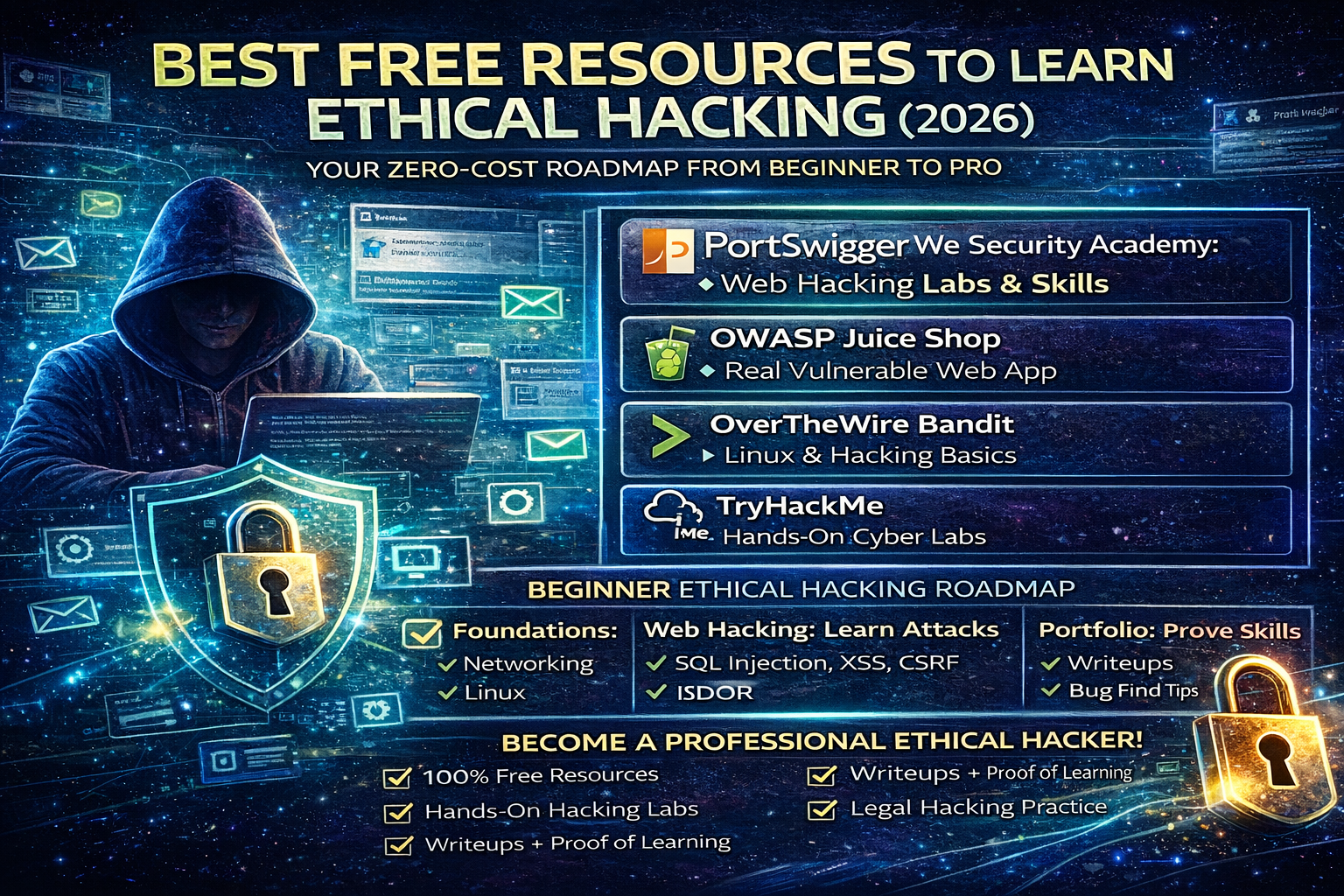
Best Free Resources to Learn Ethical Hacking (2026): A Realistic Roadmap From Beginner to Job-Ready
Learning ethical hacking in 2026 is not about downloading “hacker tools” and running them blindly. Real ethical hackers learn how systems work, then learn how they break, then learn how to test legally in safe labswhile writing clean notes and building proof of skill (writeups, labs, and small projects).
This guide is a free-only list of the best ethical hacking resources that actually teach you skills companies pay for: web hacking, Linux, networking, practical labs, and vulnerability thinking. Everything here is legal and designed for learning.
What “Ethical Hacking” Really Means (Quick Reality Check)
Ethical hacking = authorized security testing. You only test systems you:
- own, or
- have written permission to test, or
- are intentionally vulnerable training labs (CTFs)
If you want long-term success, keep your learning 100% legal. The best hackers are also the most disciplined about scope.
The Best Free Ethical Hacking Resources (2026)
1) PortSwigger Web Security Academy (Free) — Best for Web Hacking Skills
If you want to learn real web vulnerabilities (SQLi, XSS, CSRF, SSRF, auth bypass, etc.) with hands-on labs, this is one of the strongest free resources on the internet. It’s built by the same company behind Burp Suite.
Why it’s elite
- Clear explanations + practical labs
- Updated by a professional research team
- You learn the “why” (not just tool clicking)
Best for
- Beginners to intermediate
- Anyone who wants web pentesting skills that transfer to real work
How to use it (simple plan)
- Start with authentication, access control, and SQLi labs
- Write notes: “vulnerability → impact → detection → prevention”
- Keep screenshots + a small writeup per topic
2) OWASP Juice Shop (Free) — Best “Realistic” Vulnerable Web App
OWASP Juice Shop is an intentionally insecure web application used for training, demos, and CTF-style learning. It includes vulnerabilities aligned with OWASP Top Ten and many other real-world flaws.
Why it’s powerful
- Feels like a real application
- Lets you practice end-to-end exploitation safely
- Great for building a portfolio of writeups
Best for
- Web hacking practice
- Anyone preparing for bug bounty / junior pentesting roles
Pro tip
Don’t “solve it fast.” Use it like a professional: map endpoints, find weak auth flows, test input points, document everything.
3) OWASP WebGoat (Free) — Best for Learning Web Vulnerabilities (Java-focused)
WebGoat is a deliberately insecure application designed to teach common web vulnerabilities, especially in a Java-style environment.
Why it’s good
- Structured lessons
- Helps you understand logic errors and secure coding patterns
- Great if you want appsec knowledge beyond “just hacking”
4) OverTheWire (Bandit) — Best Free Linux + Security Fundamentals
A shocking amount of ethical hacking success comes from Linux comfort: files, permissions, SSH, processes, and basic enumeration. Bandit is aimed at absolute beginners and teaches fundamentals that unlock more advanced wargames.
Why it’s essential
- You learn by doing
- Builds confidence in command-line logic
- Helps you think like a solver (which is hacking)
5) TryHackMe (Free Content) — Best Beginner-Friendly Hands-On Learning
TryHackMe is designed to make cybersecurity learning accessible through guided, practical labs and beginner-friendly paths, with free options available.
Why it works
- Structured learning with clear progression
- Great for beginners who need “what to do next”
- Helps you build consistency and momentum
Best for
- Beginners who want guided rooms
- Anyone who learns faster by practice than reading
6) Hack The Box Academy (Some Free Modules) — Best for Deeper Skill Building
Hack The Box Academy is widely used for practical offensive skill development and structured learning modules (with some free access options depending on modules and promotions).
Why it’s valuable
- More “real pentest thinking”
- Strong technical depth when you’re ready
7) Cisco Networking Academy: Ethical Hacker (Free Course Option)
Cisco offers an “Ethical Hacker” course under NetAcad that is positioned as free online learning for offensive security skills.
Why it’s useful
- Structured curriculum feel
- Good for learners who want a classroom-style flow
- Complements hands-on labs from PortSwigger/OWASP
The Best Free Roadmap to Learn Ethical Hacking (2026)
Most people fail because they jump randomly between tools. Here’s a clean, realistic progression.
Phase 1: Foundations (7–14 days)
Goal: Understand the basics of systems and security thinking.
Learn:
- Networking basics (HTTP/HTTPS, DNS, ports)
- Linux basics (files, permissions, SSH)
- Web basics (requests, cookies, sessions)
Best free resources:
- OverTheWire Bandit for Linux fundamentals
- TryHackMe beginner content for guided learning
You’re ready to move on when you can explain:
- What happens when a browser loads a website
- What cookies and sessions are (and why they matter)
- Why permissions and misconfigurations create vulnerabilities
Phase 2: Web Hacking Core (2–6 weeks)
Goal: Become dangerous (legally) at the most in-demand area: web apps.
Learn and practice:
- Authentication and access control mistakes
- SQL Injection, XSS, CSRF basics
- IDOR, SSRF fundamentals
- Secure coding mindset (what the fix looks like)
Best free resources:
- PortSwigger Web Security Academy (labs + explanations)
- OWASP Juice Shop for realistic practice
Professional habit that makes you rank up fast
For every vulnerability you learn, write a mini template:
- What it is
- Why it happens
- How to test
- Impact
- How to fix
- How to prevent in the future
This turns you from “tool user” into “security thinker.”
Phase 3: Build Portfolio Proof (ongoing)
Goal: Show real progress and credibility.
Do:
- Write 5–10 clean writeups (no illegal targets)
- Post “learning notes” on your blog
- Document labs you completed and what you learned
Best free targets:
- PortSwigger labs writeups (explain concepts, not secrets)
- Juice Shop findings + prevention checklist
How to Practice Ethical Hacking Safely (Without Getting in Trouble)
Practice only on:
- your own test environment
- intentionally vulnerable apps (OWASP, PortSwigger labs)
- CTF platforms and wargames like OverTheWire
Avoid:
- scanning random websites “to learn”
- testing login forms of real businesses
- exploiting anything you don’t own
That’s not ethical hacking, and it destroys careers.
Common Beginner Mistakes (And How to Avoid Them)
Mistake 1: Learning tools before learning concepts
Tools change. Concepts don’t. Learn why vulnerabilities exist first.
Mistake 2: Only watching videos
Watching feels productive, but labs create skill. Make your learning 70% practice.
Mistake 3: No notes, no portfolio
If you can’t explain what you learned, you’ll forget it. Write simple notes every day.
Mistake 4: Skipping Linux + web fundamentals
Most beginners want “Kali Linux hacks,” but fundamentals make you faster than any tool.
About The Author