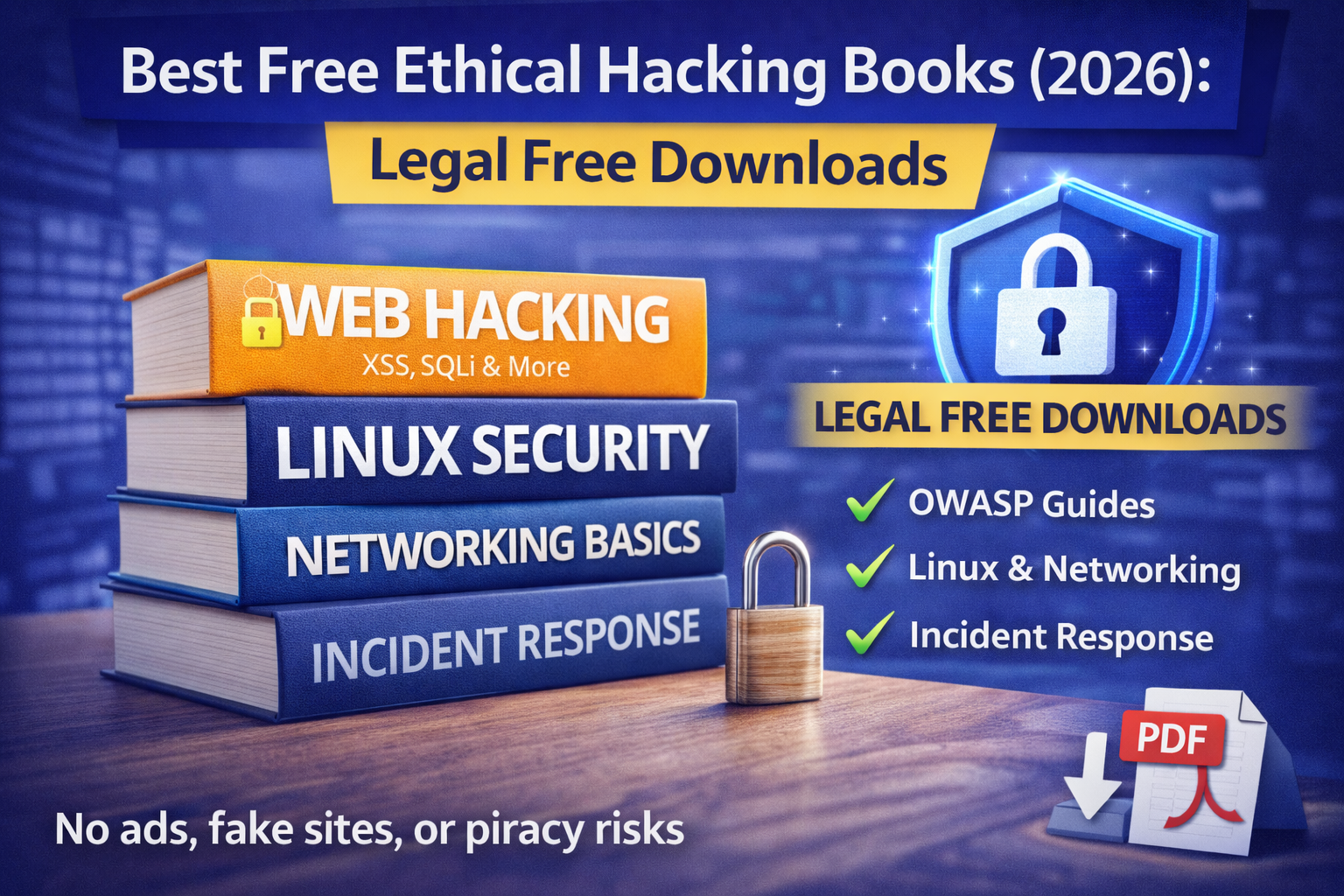
Best Free Ethical Hacking Books: Legal PDFs & Official Free Downloads in 2026
Most people search “free ethical hacking books PDF” because they want to start learning fast without paying for expensive bundles. The problem is: many “free PDF” sites host pirated copies, packed with ads, trackers, or malware. If you’re serious about cybersecurity, downloading random PDFs is one of the easiest ways to infect your device or get into legal trouble.
The good news: in 2026 there are tons of high-quality ethical hacking and cybersecurity books you can read for free legally. Many are official publications, free online handbooks, open-source books, or author-approved downloads. And they’re often better than shady “PDF collections,” because they get updated and are trusted by the security community.
In this guide, you’ll get:
- The best free ethical hacking books you can access legally
- What each is best for (web hacking, Linux, networking, blue team, OSINT)
- A beginner roadmap: what to read first, and what to practice after each book
- Tips to avoid fake “free PDF” traps
Quick rule: “Free PDF” vs “Legal free”
Before the list, remember this:
✅ Legal free = official website, publisher page, author page, reputable open-source repository, or recognized org (OWASP, NIST, etc.)
❌ Risky free = random “PDF drive” sites, Telegram dump links, unknown file-hosters with forced downloads
If you want to rank for “free PDF” keywords (high traffic) while staying safe, your blog should always emphasize official free sources.
Best free ethical hacking books
1) PortSwigger Web Security Academy
Best for: web hacking fundamentals (XSS, SQLi, auth, access control)
This is one of the most practical “free books” because it reads like a structured guide and includes hands-on labs.
What you’ll learn
- modern web vulnerabilities
- how real attacks work
- how to prevent them (developer + defender view)
Perfect for: beginners who want real skills, not theory.
2) OWASP Web Security Testing Guide (WSTG)
Best for: a full web app testing methodology (ethical, structured)
The OWASP WSTG is like a free professional handbook for web testing.
What you’ll learn
- how to test web apps step-by-step
- what to check in authentication, sessions, input validation, APIs
- how to write findings clearly
Perfect for: bug bounty learners and web security students.
3) OWASP Cheat Sheet Series (fast practical “mini-books”)
Best for: quick “how to secure it” references
These are short, high-quality guides that help you understand real defenses:
- password storage
- session management
- authentication
- CORS, CSP, and more
Perfect for: readers who want quick answers + developer-friendly prevention.
4) NIST Cybersecurity resources (free, trusted, defensive foundation)
Best for: security fundamentals, risk, incident response concepts
NIST publications are not “hacking books” in the flashy sense, but they are trusted and used in real organizations.
Perfect for: blue team mindset + building professional credibility.
5) Linux and networking fundamentals (free official docs + guides)
Ethical hacking becomes easy when you understand:
- Linux basics
- networking basics (DNS, TCP/UDP, HTTP/HTTPS)
Instead of random PDFs, use official docs and reputable open guides that teach:
- command line
- permissions
- services and ports
- troubleshooting
Perfect for: Termux learners and Android-first cybersecurity beginners.
Best free “books” by learning goal
If your goal is Web Hacking (highest beginner ROI)
Start with:
- PortSwigger Web Security Academy
- OWASP WSTG
- OWASP Cheat Sheets (sessions, auth, input validation)
Then practice:
- OWASP Juice Shop labs
- safe training platforms (CTFs / web labs)
If your goal is Bug Bounty (real-world practice)
Start with:
- web security fundamentals (PortSwigger + OWASP)
- write simple reports (impact + reproduction + fix)
Then practice:
- legal labs first
- then beginner-friendly bug bounty targets (within scope)
If your goal is “Phone learning” (Android + Termux)
Start with:
- Linux basics + command line habit
- networking fundamentals (ports, DNS, HTTP)
- basic web security concepts
Then practice:
- Termux commands
- browser-based labs (safe)
If your goal is Blue Team / Defensive
Start with:
- incident response concepts
- logging mindset (what happened, how to investigate)
- phishing/BEC awareness and process controls
Then practice:
- IR checklists
- log analysis practice with sample datasets
Beginner reading roadmap (simple + effective)
Week 1: Fundamentals (the “why”)
- Learn the basics of networking: DNS, HTTP/HTTPS, ports
- Learn Linux basics: files, permissions, processes
Practice: simple Termux commands + basic web browsing safety
Week 2: Web hacking basics (the “how attacks happen”)
- XSS, SQL injection concepts
- authentication and sessions
Practice: beginner labs (PortSwigger)
Week 3: Methodology (the “how to test properly”)
- follow OWASP testing structure
Practice: test a training app (Juice Shop) with a checklist
Week 4: Report writing + defense (the “how to be professional”)
- write findings clearly
- learn prevention cheat sheets
Practice: create 3 writeups: XSS, IDOR, SQLi (with fixes)
How to avoid fake “free PDF” traps
When people search “free ethical hacking books PDF,” they often land on sites that:
- force downloads
- inject ads
- bundle malware
- host pirated content
FAQs
Where can I get ethical hacking books for free legally?
Look for official training platforms (like PortSwigger), OWASP guides, NIST resources, and author/publisher-approved downloads. Avoid random PDF dump sites.
Are “free ethical hacking PDFs” safe?
Some are safe (official sources), but many are unsafe or illegal copies. Always use trusted websites and legal downloads.
What should a beginner read first?
Start with networking + Linux basics, then web security fundamentals (XSS, SQLi, auth), then a structured testing methodology (OWASP WSTG).
About The Author