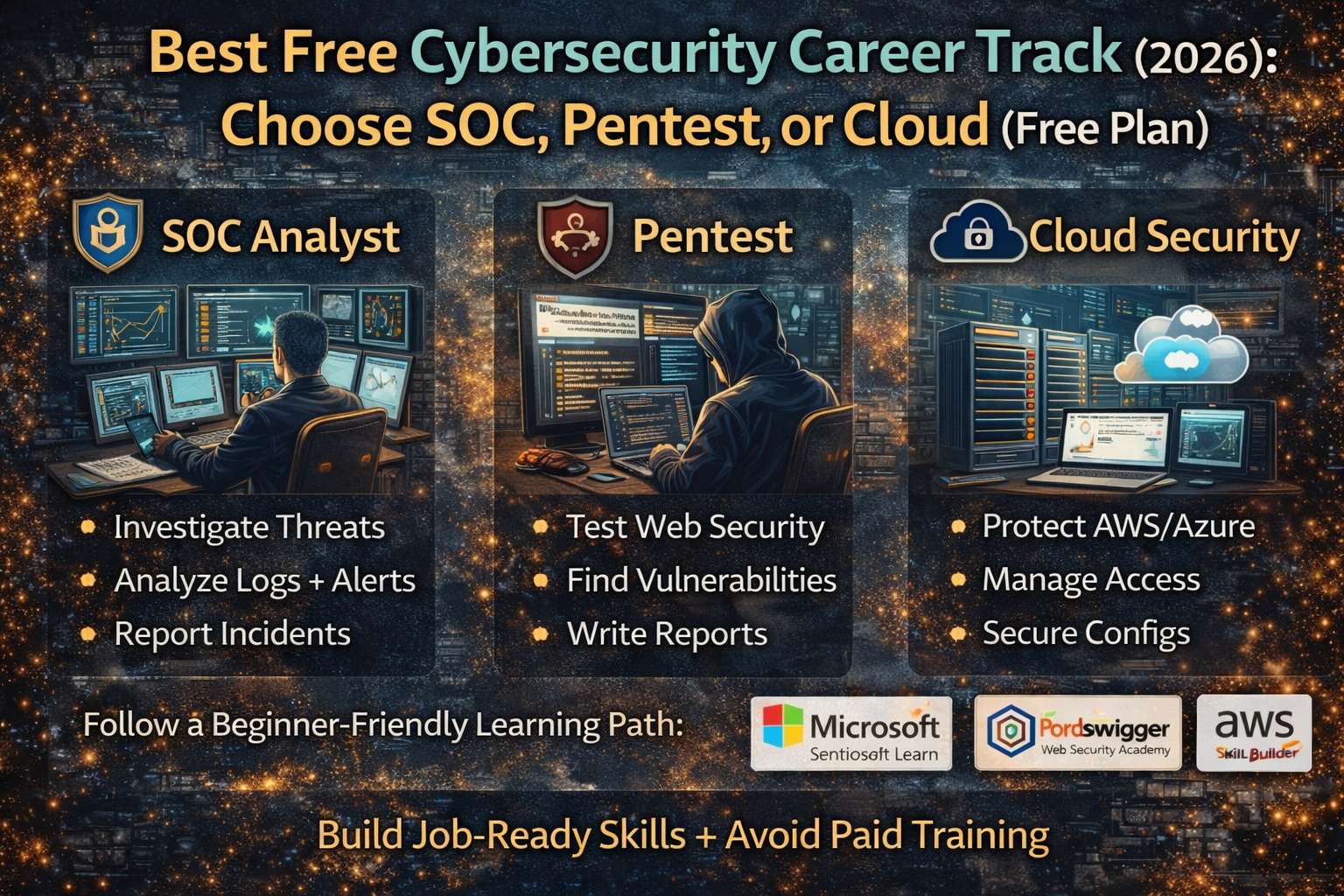
Best Free Cybersecurity Career Track 2026
If you’re a beginner in cybersecurity, the biggest mistake is trying to learn everything at once. Cybersecurity is a huge field, and “I want to learn cybersecurity” is like saying “I want to learn medicine.” You’ll grow faster when you choose a clear career track and follow a simple plan that matches it.
In 2026, the three most beginner-friendly tracks are:
- SOC (Security Operations Center) — defensive work: monitoring alerts, investigating attacks, writing reports
- Pentesting (Ethical Hacking) — offensive work: finding vulnerabilities and testing security safely
- Cloud Security — securing AWS/Azure/GCP: identity, access, monitoring, and cloud risk
This guide helps you choose the right track (even if you’re starting from zero) and gives you a fully free training plan you can follow step-by-step using trusted platforms.
Choose Your Track: SOC vs Pentest vs Cloud
Choose SOC if you like investigation and problem-solving
SOC work feels like being a cyber “detective.” You look at suspicious activity, figure out what happened, and help stop it. If you enjoy understanding how attacks work and writing clear explanations, SOC is one of the most realistic entry-level paths.
SOC skills you’ll build first:
- reading security alerts
- understanding logs and suspicious patterns
- basic incident response thinking
- reporting what happened in simple words
A strong free learning foundation for SOC is Microsoft Learn’s security operations analyst training and Microsoft Sentinel learning modules.
Choose Pentest if you like finding weaknesses and testing systems
Pentesting is what most people imagine when they hear “ethical hacking,” but the real job is not about drama—it’s about structured testing, documenting weaknesses, and helping fix them. Pentest is best if you enjoy hands-on labs and learning how vulnerabilities happen.
Pentest skills you’ll build first:
- web security fundamentals (XSS, SQLi, auth issues)
- basic Linux and networking
- understanding how to write a clear vulnerability report
One of the best free lab-based resources for beginners is PortSwigger Web Security Academy (free web security training and labs).
Choose Cloud Security if you want high-demand skills and stable job paths
Cloud security is one of the strongest long-term tracks because cloud services are everywhere. Beginners can start here even without deep hacking skills. Cloud security focuses on identity, access control, secure configuration, logging, and monitoring.
Cloud skills you’ll build first:
- cloud fundamentals (what cloud services are and how they work)
- identity and access management (IAM) basics
- logging/monitoring concepts
- common misconfiguration risks
A strong free foundation is AWS digital training (AWS states access to 900+ free self-paced digital courses) and AWS Skill Builder learning plans (including security learning plans).
The “Common Person” Decision Test (Pick in 60 Seconds)
Pick SOC if:
- you like investigation, analysis, and explaining things clearly
- you want a realistic entry path without needing advanced hacking early
- you want a track that fits many roles (SOC, IR, analyst, security monitoring)
Pick Pentest if:
- you enjoy hands-on testing and “finding the bug”
- you like labs and practical exercises
- you can stay patient and learn step-by-step (web + basics first)
Pick Cloud Security if:
- you want stable demand and modern career opportunities
- you like platforms and configuration more than exploiting
- you want a path that fits remote jobs and global companies
If you still feel stuck: start with SOC. It teaches how attacks work, how to investigate, and builds a strong base that can later move into pentest or cloud.
The Best Free Cybersecurity Career Track Plan (2026)
Step 1: Get a trusted foundation credential (free option when available)
A strong beginner credential helps your profile look serious. One of the most credible entry-level options is ISC2’s Certified in Cybersecurity (CC) program, offered as free training + free exam initiative (availability depends on the program terms).
This is useful for all three tracks because it covers core security fundamentals that apply everywhere.
Track 1: SOC Analyst (Free Plan)
SOC is one of the best tracks for common people because the learning path is clear and job-aligned.
Start with Microsoft Learn’s Security Operations Analyst training pathway, then learn the basics of Microsoft Sentinel (SIEM).
A realistic SOC free plan looks like this:
In the beginning, focus on understanding what alerts mean and how investigations work. Microsoft Learn’s content helps you learn what a SIEM is and why Sentinel exists, and how SOC analysts approach threats.
By the end of this track, you should be able to explain incidents in simple language, recognize suspicious patterns, and understand the SOC workflow from alert → investigation → response.
Track 2: Pentesting (Ethical Hacking) (Free Plan)
Pentesting becomes easy when your plan is simple: learn the basics, then practice in legal labs.
Start with web security labs and learn vulnerabilities in a safe training environment. PortSwigger Web Security Academy is built for exactly this style of learning, and it includes practical labs that match real-world web vulnerabilities.
A clean pentest free plan looks like this:
First you build web security fundamentals (how websites work, where vulnerabilities come from). Then you practice step-by-step labs. Then you write short “what I tested + what it means” writeups. In pentesting, writing is part of the job—good reports create trust.
If your goal is bug bounty later, this track naturally feeds into it because it builds real web testing skills.
Track 3: Cloud Security (Free Plan)
Cloud security is beginner-friendly when you learn in this order: cloud basics → security basics → security services → monitoring.
AWS provides free self-paced digital training (AWS describes access to 900+ free digital courses) and AWS Skill Builder has security learning plans.
A practical cloud security free plan looks like this:
Start with basic AWS concepts, then move into security learning plans and the idea of securing identities, permissions, and configurations. Cloud security is often about preventing mistakes that attackers exploit—like overly open permissions, exposed storage, weak policies, or missing monitoring.
Over time, cloud security connects strongly to SOC work too, because cloud environments generate logs and detections that security teams monitor.
Which Track Gets Jobs Faster for Beginners?
For most beginners with no technical background, SOC is usually the fastest path because it’s close to entry-level work: learning how to monitor, investigate, and report. Microsoft’s security operations training path is designed around that role.
Pentest can also lead to opportunities, but it typically takes longer because it requires stronger hands-on practice, deeper fundamentals, and stronger proof-of-work.
Cloud security can be very strong, especially if you consistently build skills using structured vendor training (like AWS training paths).
A Simple “Free Track Stack” That Looks Clean on a CV
A beginner-friendly profile often looks strongest like this:
- Foundation credential (CC when free exam offer is available)
- Track skill training (SOC via Microsoft Learn OR Cloud via AWS training OR Web labs via PortSwigger)
- Proof-of-work (short writeups, lab logs, or mini reports)
This combination builds trust because it shows structured learning and real output.
The best free cybersecurity career track in 2026 is the one you can follow consistently. SOC is ideal if you want a realistic entry-level path through investigation and reporting. Microsoft Learn provides a direct SOC training pathway and Sentinel learning modules for beginners. Cloud security is powerful if you want modern, high-demand skills, and AWS provides extensive free digital training plus security learning plans. And if your goal is ethical hacking, a lab-first pentest approach builds real skill and proof faster than collecting random certificates.
About The Author