Best Free CTF Platforms for Absolute Beginners (2026)
If you’re techie person who wants to learn cybersecurity from scratch, you don’t need expensive courses or a computer science degree. What you need is structured practice and that’s exactly what CTFs (Capture The Flag challenges) provide.
A CTF is a safe training environment where you solve small security puzzles and submit a “flag” (a hidden code) to prove you solved it. Instead of reading theory for weeks and forgetting it, you learn by doing: you open a file, decode a string, inspect a webpage, spot a weakness, and learn a real concept in minutes.
The problem most beginners face is this: they start on the wrong platform, pick challenges that are too hard, get stuck, and quit. This guide fixes that by showing you the best free CTF platforms for absolute beginners plus exactly how to start, what to learn first, and how to build confidence without feeling overwhelmed. Also If you’re absolute beginner, start with best free platforms to learn ethical hacking before you jump into harder CTF tracks
What “beginner-friendly” actually means
Many platforms say “beginner,” but beginners still struggle because the platform might be beginner-friendly in name only. A truly beginner-friendly CTF platform has:
Clear learning guidance
You should see short explanations, hints, or learning paths that tell you what to do next.
Low setup friction
If you need five tools, three VMs, and confusing commands on Day 1, you’ll burn out. Beginners should be able to start in a browser or with minimal setup.
Progressive difficulty
You should be able to win quickly at the start, then gradually level up.
Legal, safe practice by design
Beginner platforms should train you on intentionally vulnerable puzzles—not real targets.
Strong fundamentals coverage
The platform should teach the “base layer” of cybersecurity: Linux basics, web basics, cryptography basics, file/forensics basics.
Community or documentation
When you get stuck, you should be able to learn why, not just copy.
If a platform misses these, it may still be great later—but it’s not your best Day-1 choice.
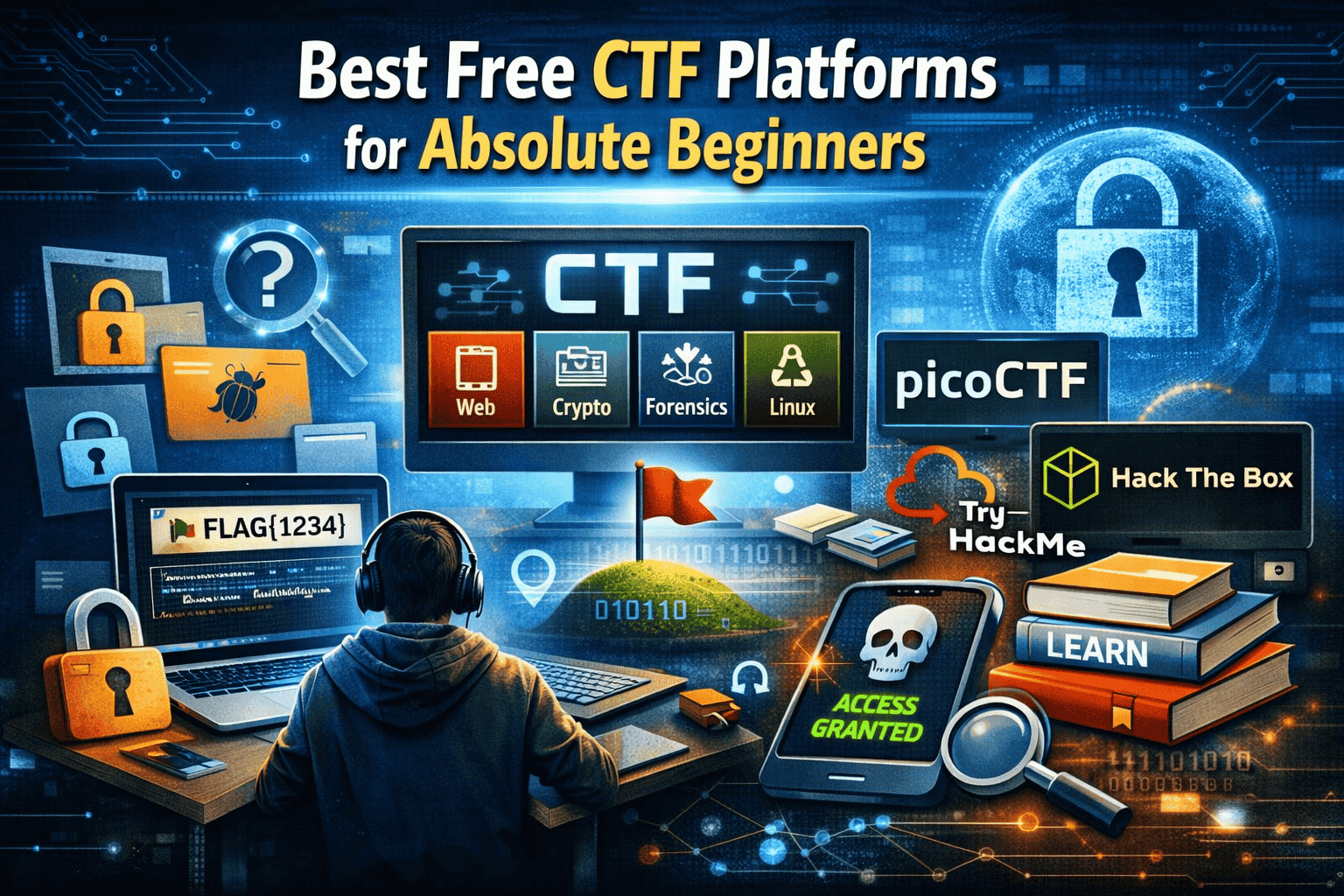
The short list: best free CTF platforms for beginners
If you want the “just tell me what to start with” answer:
Best 2-platform combo for fastest progress
- picoCTF (general beginner cybersecurity puzzles)
- PortSwigger Web Security Academy (web security fundamentals and labs)
That combo gives you both breadth and job-relevant depth, without overwhelming you.
1) picoCTF
If you have never done a CTF before, start here.
picoCTF is built specifically as a beginner training program. The challenges are designed to teach concepts in small bites—so you can learn in 20–40 minute sessions and still feel real progress.
Why picoCTF beats most competitors for beginners
Most CTF sites assume you already know Linux commands, basic networking, and how to use tools. picoCTF doesn’t. It gives you puzzles that teach you the basics while you solve them.
You’ll commonly learn:
- how to read files and extract information
- how to recognize common encoding formats
- how to interpret simple web page clues
- how to think like a problem-solver (the #1 CTF skill)
How to use picoCTF
Don’t chase hard challenges. Don’t jump categories randomly. Do this:
Step 1: Start with the easiest “General Skills” challenges
Your goal is early wins. Early wins build confidence.
Step 2: Keep a “CTF Journal” from Day 1
One simple notes file makes you improve faster than 90% of beginners.
Use this format:
- Challenge name + category
- What you tried
- What worked
- What you learned
- New commands/terms
Step 3: When you get stuck, use hints strategically
A hint isn’t failure. A hint is a mini-lesson. Read it, learn the concept, write it down.
Beginner mindset that beats competitors
The best CTF learners don’t try to “look smart.” They try to learn one repeatable lesson per challenge.
2) PortSwigger Web Security Academy
If you want a “modern skill” that is valuable in the US and Europe job markets, web security is one of the best places to focus. PortSwigger Web Security Academy is a free training platform with lessons and labs that teach web vulnerabilities in a structured way.
Why this platform is perfect for beginners (and better than random YouTube)
Beginners often search “XSS tutorial” or “SQL injection example” and end up in content that is:
- too technical too soon
- incomplete
- unsafe to practice
- focused on attack steps without understanding
PortSwigger is different because it:
- teaches the concept first (in plain language)
- provides safe labs where you practice legally
- gives you a structured path so you don’t get lost
How to start without getting overwhelmed
Start with web fundamentals first. Your learning order should be:
- How websites work (requests, responses, cookies, sessions)
- Authentication basics (logins, sessions, reset flows)
- Common beginner vulnerabilities (high-level understanding → then labs)
Important: Don’t aim to memorize everything. Aim to understand the “why” behind each vulnerability.
Prefer a step-by-step curriculum? Use these best free ethical hacking courses and do CTF alongside them
3) OverTheWire Bandit
A huge number of beginners get stuck in cybersecurity because they avoid Linux. But Linux is not something you “study” forever—it’s something you learn by doing small tasks repeatedly.
OverTheWire’s Bandit is a legendary beginner ladder because it teaches you the command line in small steps.
What you gain from Bandit (real value)
By the end of the early levels, you’ll be comfortable with:
- navigating directories
- reading files
- searching for text
- understanding permissions
- using simple pipelines
This is foundational. Without basic Linux, many CTF challenges will feel like a foreign language.
Best way to use it
Do 1–2 levels per day and take notes of every new command. Consistency is the secret.
4) TryHackMe
Some people don’t learn well from puzzle-only platforms. They want structured lessons, explanations, and guided labs. That’s where TryHackMe’s free rooms are useful.
Why beginners love TryHackMe
It feels like a course—but you still learn by doing.
It’s great for:
- Linux and networking basics
- beginner security concepts explained in a friendly way
- hands-on tasks that build confidence
How to avoid the #1 TryHackMe beginner mistake
The mistake: jumping into “hacking” rooms too early.
Instead, start with:
- basic Linux
- basic networking
- web basics
That ordering makes everything later easier.
5) Hack The Box Starting Point
Hack The Box can feel intimidating, but “Starting Point” exists to guide absolute beginners into the HTB style.
When to start HTB (honest advice)
Don’t start HTB on Day 1.
Start HTB after you have:
- basic Linux confidence (Bandit helps)
- basic web understanding (PortSwigger helps)
- a few CTF wins (picoCTF helps)
Then Starting Point becomes exciting instead of frustrating.
Why it’s useful long-term
HTB feels closer to real workflows (enumeration → finding clues → exploiting → learning). It helps you think in steps, not guesses.
6) CTFlearn
CTFlearn is useful as a practice gym because it has a wide variety of beginner-friendly challenges. It can help you strengthen common categories like:
- basic crypto puzzles
- simple web challenges
- beginner forensics tasks
Best way to use it
Use it as a supplement. Don’t let it replace a structured path like picoCTF + PortSwigger.
7) Root-Me
If your audience is US + Europe, Root-Me is a strong platform to include in your “next level” section because it has a big community and lots of challenges across categories.
Who should use Root-Me
Use Root-Me after your first month, when you can already:
- handle basic Linux tasks
- read simple web requests/cookies
- solve entry-level crypto/forensics puzzles
The beginner setup you actually need
You don’t need fancy tools to start. Don’t let “setup” become procrastination.
Minimum setup (Day 1)
- a laptop/PC
- a browser
- a notes app (Notion/Google Docs) or a plain text “CTF Journal”
Optional setup (Week 2–3)
- a Linux VM (only when you understand why you need it)
- basic utilities (zip, text editor)
Beginner truth: Your brain and your notes are your best tools at the start.
A simple 30-day beginner CTF plan
Week 1 — Confidence + fundamentals
- picoCTF: easiest General Skills challenges (aim for daily small wins)
- OverTheWire Bandit: levels 0–7
- Create your CTF Journal and keep it daily
Week 2 — Web basics that pay off fast
- PortSwigger: web basics + beginner labs
- Goal: understand cookies, sessions, login behavior
Week 3 — Guided learning for structure
- TryHackMe: focus on Linux + networking basics rooms
- Goal: learn “how to think” through steps, not guess
Week 4 — Realistic lab mindset
- Hack The Box Starting Point (only the beginner tier)
- Goal: practice a simple workflow (enumerate → find clue → solve)
If you do 30–60 minutes daily for 30 days, you’ll be shocked how far you’ll go.
Common beginner mistakes that competitors don’t warn you about
Mistake 1: Starting with advanced challenges
This kills motivation. Start easy, build momentum, then level up.
Mistake 2: Copying writeups line-by-line
If you copy without learning, you won’t improve. If you read a writeup to understand why, you will.
Mistake 3: No notes
Without a journal, you forget and repeat mistakes. With notes, you build a personal “security brain.”
Mistake 4: Platform hopping
Pick 1–2 platforms per week. Focus beats variety.
Mistake 5: Confusing CTF practice with real hacking
Only practice in legal training environments. Never test real systems without permission.
FAQs
Are CTF platforms legal?
Yes when you use platforms designed for training and intentionally vulnerable challenges. Avoid real systems you don’t own or lack permission to test.
Which free platform should I start with today?
Start with picoCTF for general beginner skills and add PortSwigger Web Security Academy for web fundamentals.
Do I need Kali Linux to start?
No. You can start with a browser, notes, and basic Linux practice. Add a Linux VM later.
How long until I feel “intermediate”?
With consistent practice (30–60 minutes/day), many beginners feel intermediate in 6–10 weeks, especially if they take notes and follow a structured path.
About The Author