Best Free CTF Forensics Challenges for Beginners (2026)
CTF forensics is often described as the most beginner-friendly category in Capture The Flag competitions, and for good reason. Unlike exploitation or advanced cryptography, forensics does not require you to hack servers, bypass authentication, or write complex code. Instead, it focuses on analyzing digital evidence carefully, understanding how files are structured, and discovering information that has been hidden or overlooked.
Forensics is ideal for beginners because it emphasizes thinking and observation, not technical aggression.
In beginner CTFs, forensics helps you build confidence by allowing you to:
- Work with real-world file types like images, documents, and archives
- Make progress without advanced Linux or programming skills
- Solve challenges through logic rather than speed
Unlike other CTF categories where one mistake can block all progress, forensics challenges often give you multiple clues, encouraging exploration instead of frustration.
What Beginner CTF Forensics Challenges Actually Teach You
Beginner forensics challenges simulate the role of a digital investigator. You are given evidence and asked to answer questions like what happened, what is hidden, or what detail was overlooked.
Through consistent practice, beginners learn how to:
- Look beyond surface-level content
A file that looks normal may contain hidden metadata, embedded text, or extra data appended to it. - Understand how digital evidence is created
Images, documents, and media files automatically store information about their origin. - Follow a structured investigation process
Instead of guessing, you check file type → inspect metadata → analyze content → extract hidden data. - Develop patience and analytical thinking
These are essential skills for SOC analysts and incident responders.
Forensics teaches you that answers are usually already there — you just need to know where to look.
Forensics skills are heavily used in defensive security roles. Exploring blue team CTF practice helps beginners understand how forensic analysis supports detection, investigation, and incident response in real-world environments.
Best Free CTF Forensics Platforms for Beginners (2026)
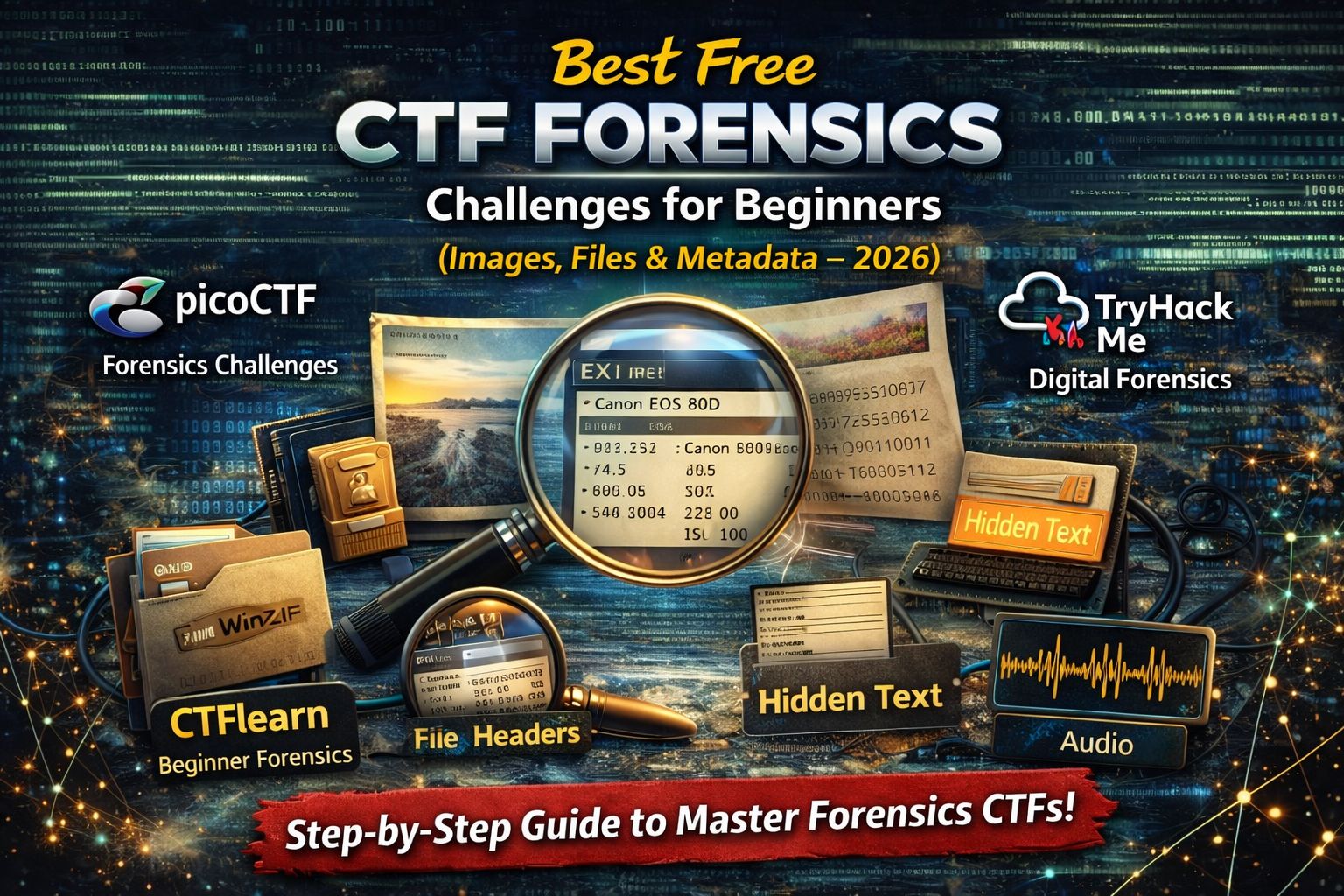
picoCTF – Forensics Challenges (Best Place to Start)
For absolute beginners, picoCTF offers the safest and most structured introduction to CTF forensics.
picoCTF is beginner-friendly because:
- Challenges start at a very low difficulty
- Instructions are written clearly
- Hints explain concepts instead of spoiling answers
Forensics skills you practice on picoCTF
- Image analysis
Many picoCTF challenges use images where the visible picture is not the real challenge. Beginners learn that images can store hidden data in metadata, color channels, or appended content. - Metadata extraction
You learn how files reveal information such as creation time, author, device details, or hidden comments that directly lead to flags. - File format verification
picoCTF teaches that file extensions can lie. By checking file headers, you learn the true nature of a file. - Introductory steganography
You begin to understand how text or files can be hidden inside images or audio without obvious visual changes. - Archive inspection
Many challenges hide files inside ZIP or compressed archives, teaching safe extraction and inspection habits.
picoCTF builds a habit of methodical investigation, which is critical for real-world digital forensics.
If you are completely new to CTFs and want a structured way to start before diving into forensics, following a clear picoCTF beginner practice path can help you understand how CTF challenges are designed and how to approach them confidently.
CTFlearn – Beginner Forensics Reinforcement
CTFlearn is excellent once you understand the basics and want repetition.
CTFlearn works well for beginners because:
- Challenges are short and focused
- There is little pressure to move fast
- Patterns repeat, reinforcing learning
Skills reinforced on CTFlearn (with explanation)
- Inspecting files before opening them
You learn not to trust file names and to analyze structure first. - Finding hidden text and data
Many challenges hide clues in places beginners usually ignore. - Recognizing common forensic tricks
Over time, patterns become familiar, making future challenges easier. - Building confidence through repetition
Repeated exposure turns analysis into habit.
CTFlearn is ideal for daily practice and confidence building.
TryHackMe – Digital Forensics Rooms
TryHackMe is perfect for learners who prefer guided explanations before solving problems.
Why TryHackMe is helpful for beginners:
- Concepts are explained step by step
- Visual walkthroughs reduce confusion
- Challenges are connected to real-world scenarios
Forensics topics explained on TryHackMe (expanded)
- Metadata and timelines
Learn how investigators reconstruct events using timestamps. - Image and document analysis
Understand how attackers hide traces inside common files. - Log file basics
Learn how system and application logs are analyzed during investigations. - Incident response context
See how forensics fits into real security workflows.
TryHackMe bridges the gap between CTF learning and real cybersecurity jobs.
Common Beginner CTF Forensics Challenge Types
🖼 Image Forensics Challenges
Image forensics is one of the most common beginner tasks.
You learn to:
- Extract EXIF metadata
- Find hidden comments or text
- Detect embedded files inside images
These challenges teach how attackers hide information in plain sight.
📄 File Forensics Challenges
File forensics focuses on understanding what a file truly is.
You practice:
- Checking file headers
- Identifying mismatched extensions
- Extracting embedded content
This skill is essential in malware and incident analysis.
🗂 Metadata Analysis Challenges
Metadata often solves challenges faster than any tool.
You learn to:
- Analyze timestamps
- Identify creators and editors
- Reconstruct digital timelines
Metadata teaches you that files reveal more than intended.
🎧 Audio & Media Forensics (Beginner Level)
These challenges introduce hidden data in sound or video.
You practice:
- Inspecting media properties
- Detecting unusual patterns
- Extracting hidden information
These tasks sharpen attention to detail.
Many forensic challenges also involve encoded or lightly encrypted data. Learning how beginner crypto works through CTF cryptography challenges for beginners helps you quickly recognize whether hidden information is encoded, encrypted, or simply concealed.
Beginner-Friendly Tools for Forensics CTFs
Beginners do not need advanced tools. Safe options include:
- EXIF metadata viewers
- File inspection utilities
- Online steganography tools
- Linux commands like
stringsandfile
Tools assist analysis — logic always comes first.
Recommended Beginner Forensics CTF Learning Order
To avoid overload, follow this order:
- picoCTF forensics challenges
- CTFlearn beginner forensics
- TryHackMe digital forensics rooms
This progression builds confidence naturally.
Common Forensics CTF Mistakes Beginners Make
Beginners often struggle because they:
- Rush instead of observing
- Ignore metadata
- Depend entirely on tools
- Skip reading challenge descriptions
Forensics rewards patience and curiosity.
CTF forensics is just one part of ethical hacking. If you want to explore other beginner-friendly labs and learning environments, this guide to the best free platforms to learn ethical hacking helps you choose the right next step without wasting time.
FAQs
Is CTF forensics hard for beginners?
No. It is one of the easiest and most accessible CTF categories.
Do I need Linux skills for forensics CTFs?
Basic Linux helps, but many challenges can be solved visually.
Are forensics CTF challenges legal?
Yes. All platforms mentioned are authorized training environments.
Are forensics skills useful for jobs?
Yes. They are critical for SOC, incident response, and digital investigations.
About The Author