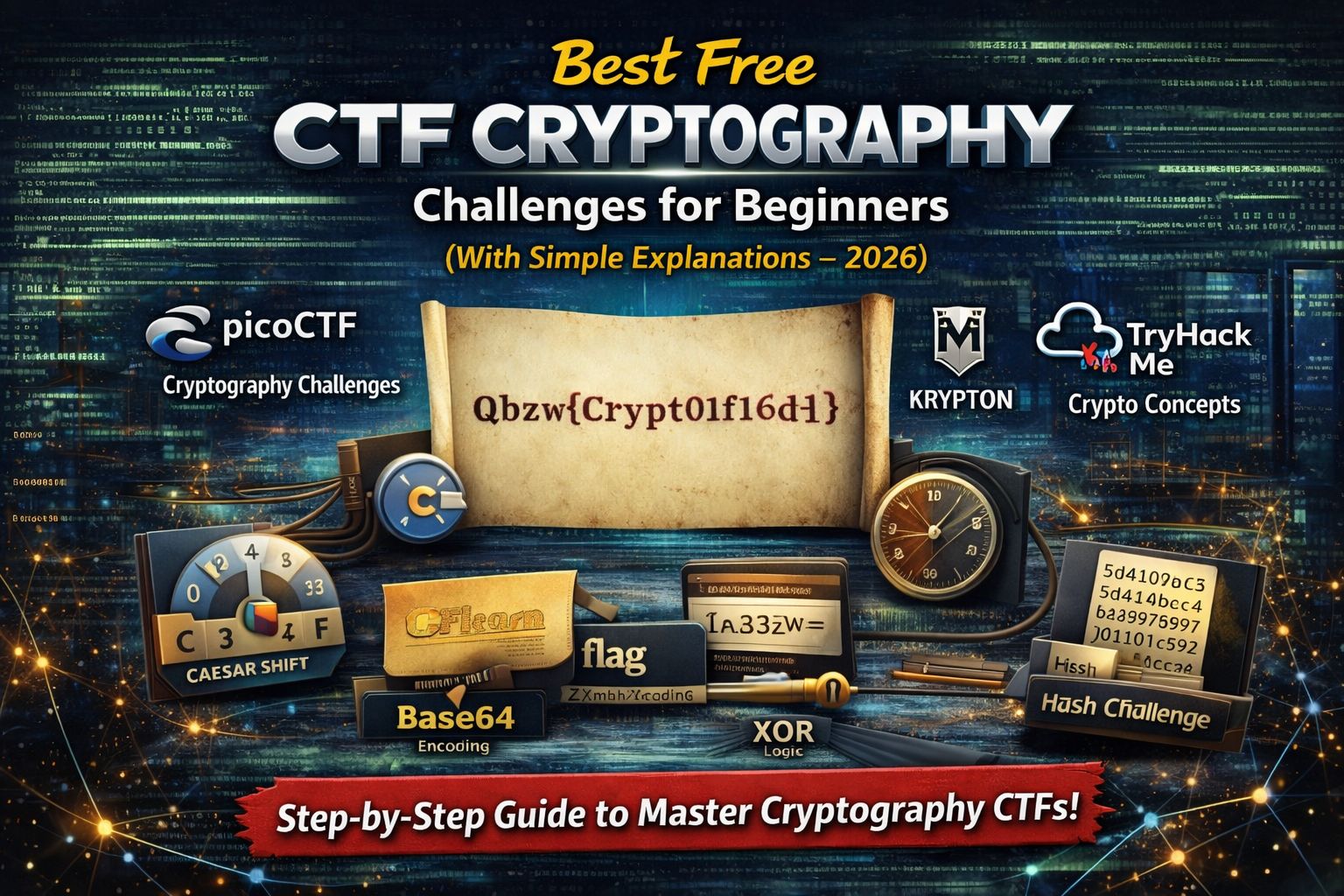
Cryptography is often the first CTF category beginners are afraid of, mainly because it sounds mathematical and complex. In reality, beginner-level cryptography CTF challenges are about logic, patterns, and careful observation, not advanced formulas or heavy theory.
Unlike exploitation or networking challenges, cryptography CTFs do not require:
- Attacking live systems
- Deep Linux knowledge
- Advanced programming skills
Instead, beginner crypto challenges focus on analyzing data and uncovering patterns. This makes them ideal for learners who are still building confidence.
Cryptography CTFs help beginners:
- Learn how data is encoded and protected
- Understand common mistakes in encryption usage
- Build logical problem-solving skills
- Gain confidence early in their CTF journey
Once beginners understand crypto CTFs, they stop seeing flags as “random strings” and start seeing structured problems with predictable solutions.
What Beginner Cryptography CTF Challenges Actually Teach
Beginner crypto CTFs are not about breaking strong encryption. They are about recognizing weak or incorrect usage of cryptography.
By practicing crypto CTFs, beginners learn to:
- Distinguish encoding from encryption
Many challenges use encoding (like Base64), not real encryption. - Identify common cipher patterns
Shifts, substitutions, repetitions, and known flag formats. - Use hints and descriptions effectively
Crypto challenges reward reading carefully. - Solve problems step by step
Guessing rarely works; logic almost always does.
These skills are valuable far beyond CTFs, especially in security analysis, malware research, and digital forensics.
Best Free CTF Cryptography Platforms for Beginners (2026)
picoCTF – Cryptography Challenges (Best Starting Point)
For beginners, picoCTF is the safest and most structured place to start learning cryptography through CTFs.
Why picoCTF crypto challenges are ideal for beginners:
- Difficulty starts very low
- Clear descriptions and helpful hints
- Focus on logic instead of mathematics
- Large collection of beginner-friendly challenges
Crypto skills you practice on picoCTF (explained)
- Caesar cipher decoding
Learn how letters are shifted and how trying all shifts quickly reveals readable text. - Simple substitution ciphers
Understand how letter frequency and common words help decode messages. - Base64 and basic encodings
Learn that encoding is reversible and often mistaken for encryption. - Introductory XOR challenges
See how repeating patterns expose weaknesses in poorly implemented crypto. - Flag format recognition
Learn how known flag patterns guide your decoding process.
picoCTF teaches beginners how to think through crypto problems, not just how to click tools.
CTFlearn – Beginner Crypto Practice
CTFlearn is excellent for reinforcing cryptography basics through short, focused challenges.
Why beginners benefit from CTFlearn:
- Challenges are small and manageable
- Low-pressure environment
- Clear success conditions
Crypto concepts reinforced on CTFlearn
- Recognizing common encodings quickly
- Applying simple cipher logic repeatedly
- Building confidence through repetition
- Understanding recurring CTF crypto patterns
CTFlearn is perfect for daily practice after learning basics on picoCTF.
OverTheWire – Krypton (Early Levels Only)
Krypton focuses on classical cryptography, making it useful once beginners are comfortable with basic crypto ideas.
Why Krypton works for beginners (early levels):
- Step-by-step progression
- Clear explanation of each cipher
- Focus on understanding weaknesses
Crypto concepts taught in Krypton
- Frequency analysis
- Weak substitution ciphers
- Classical cipher structures
- Pattern-based decryption
Beginners should only attempt early Krypton levels and skip advanced ones.
Beginner Cryptography Challenges on TryHackMe
TryHackMe is ideal for learners who prefer guided explanations before solving challenges.
Why TryHackMe helps crypto beginners:
- Concepts explained clearly before tasks
- Real-world context for cryptographic mistakes
- Guided structure reduces confusion
Crypto topics explained on TryHackMe
- Encoding vs encryption
- Hashing basics
- Weak cryptographic practices
- Practical crypto misuse scenarios
This platform is best for beginners who want learning + practice combined.
Common Beginner Cryptography CTF Challenge Types
🔐 Caesar Cipher Challenges
- Letters shifted by a fixed number
- Easily broken by trying all shifts
- Teach pattern recognition and logic
🔐 Substitution Cipher Challenges
- Each letter replaced with another
- Solved using frequency analysis
- Teach patience and structured thinking
🔐 Encoding Challenges (Base64, Base32)
- Not encryption, just representation
- Easily reversible
- Common beginner trap
🔐 XOR Challenges (Beginner Level)
- Repeating keys create patterns
- Teach weaknesses in poor crypto usage
🔐 Hash-Based Challenges (Easy)
- Identify hashing algorithms
- Understand why hashes can’t be reversed
- Learn lookup and logic-based solutions
Beginner-Friendly Tools for Crypto CTFs
Tools are helpful, but logic comes first. Beginner-safe tools include:
- Online cipher decoders (for learning)
- Python scripts for simple decoding
- Linux tools like
base64 - Frequency analysis helpers
Tools should support understanding, not replace it.
Recommended Beginner Crypto CTF Learning Order
To avoid frustration, follow this order:
- picoCTF Cryptography (easy only)
- CTFlearn beginner crypto
- OverTheWire Krypton (early levels)
- TryHackMe crypto rooms
This order builds confidence gradually.
Common Crypto CTF Mistakes Beginners Make
Beginners often struggle because they:
- Assume cryptography is “too hard”
- Ignore challenge hints
- Jump to advanced math-based crypto
- Use tools before understanding the problem
Crypto CTFs reward calm thinking and patience, not speed.
7-Day Beginner Cryptography CTF Practice Plan
Day 1–2
- picoCTF Caesar and encoding challenges
Day 3
- CTFlearn beginner crypto challenges
Day 4
- OverTheWire Krypton (early levels)
Day 5
- TryHackMe crypto basics
Day 6
- Mixed easy crypto challenges
Day 7
- Review mistakes and re-solve challenges
FAQs
Is cryptography hard for beginners?
No. Beginner crypto CTFs focus on logic, not advanced mathematics.
Do I need math skills for crypto CTFs?
No. Pattern recognition and reasoning are more important than math.
Are cryptography CTF challenges legal?
Yes. All platforms listed are authorized training environments.
Are crypto CTF skills useful for cybersecurity jobs?
Yes. Cryptography understanding is essential for security analysis and secure system design.
About The Author