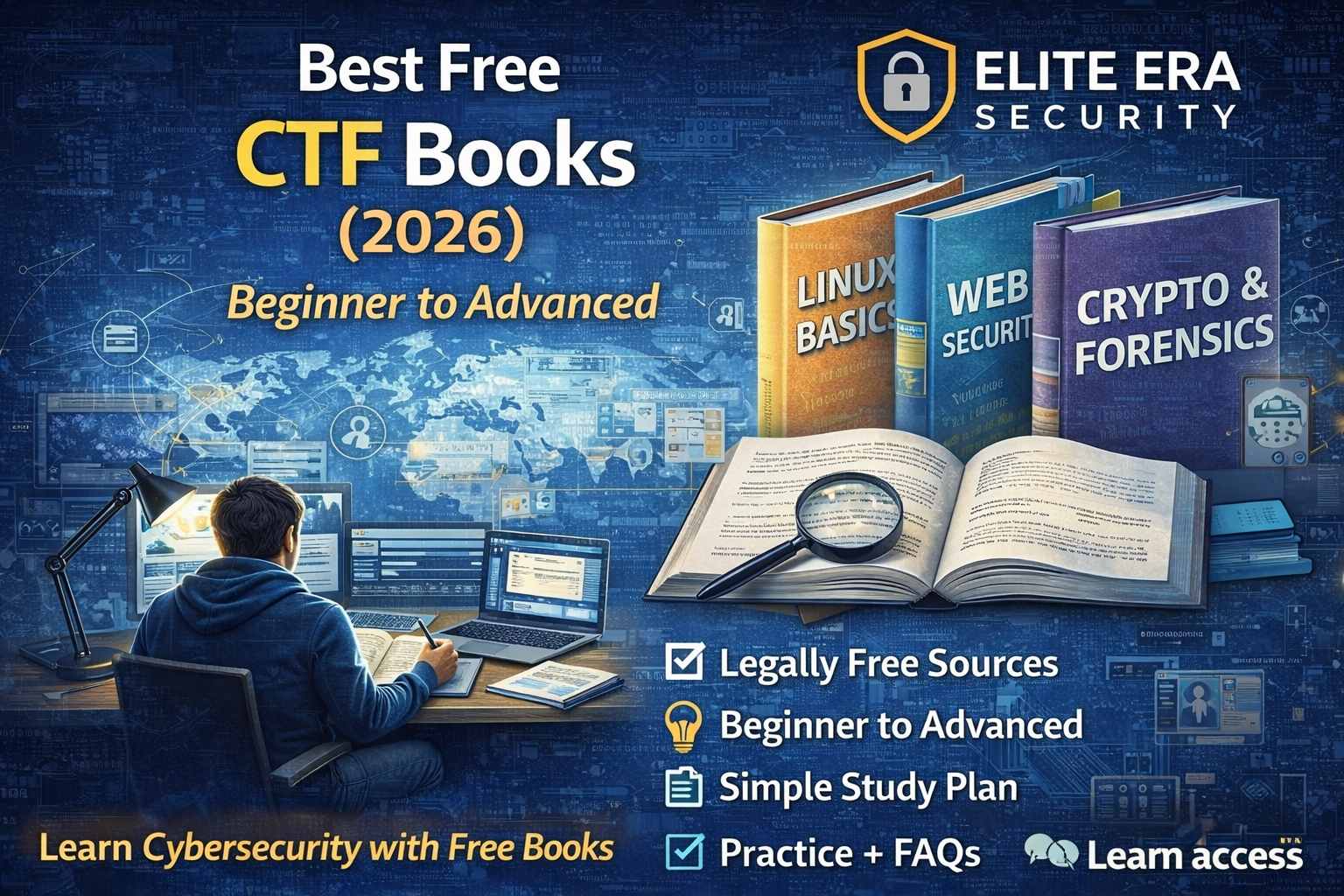
Best Free CTF Books (2026): Beginner to Advanced Books
CTF (Capture The Flag) is one of the fastest ways to learn cybersecurity but many beginners struggle because they don’t have a clear learning path. They solve random challenges, get stuck, and then jump to another platform without understanding the fundamentals.
Books solve that problem. A good cybersecurity book gives you structure, vocabulary, and a reliable way to learn concepts like web security, Linux basics, cryptography, forensics, and reverse engineering. When you pair books with CTF practice, you stop guessing—and start progressing.
If you haven’t chosen a practice platform yet, here are the best free CTF platforms for absolute beginners and what each one teaches.
This guide lists the best free CTF books and learning resources for 2026, organized from beginner to advanced. Everything here is focused on legal free access (official free PDFs, publisher previews, author-released versions, or free online books).
How to use books for CTF
Books alone won’t make you good at CTF. CTF is a skill—you build it by practice. But books make your practice faster because they teach you what to look for and how to think.
Here’s the simplest way to combine reading + CTF:
- Read for 20–30 minutes
- Practice for 30–60 minutes
- Write a short note/writeup (even 5 minutes)
This small routine creates “learning loops.” Every week, your confidence and speed improve because you’re not just solving—you’re understanding.
If you’re just starting, use this free CTF starter kit to set up your workflow, tools, and legal practice rules before you begin the book + CTF routine.
Best Free CTF Books and Resources
Below is the curated path. I’m listing books/resources by category because CTF skills are built in layers.
1) Beginner Foundations
These resources help you build the basics: terminology, core security mindset, and the “how computers actually work” knowledge that beginners usually miss.
What you should learn in this stage
- What a vulnerability is (in plain English)
- Basic networking and web basics
- Linux navigation and file handling
- How CTF challenges are structured
Best free beginner-friendly books/resources
- “The Linux Command Line” (William Shotts) – free online
Why it’s good: It teaches Linux commands slowly and clearly, which helps in almost every CTF category. - “How the Web Works” (free guides / MDN Web Docs)
Why it’s good: Web CTF becomes much easier once you understand requests, cookies, sessions, and basic HTML. - Open “Computer Networking” foundational guides (free online textbooks)
Why it’s good: If you don’t understand IP, DNS, and HTTP basics, many CTF hints feel confusing.
How to study this stage (beginner-friendly):
- Read small sections, then immediately practice one simple challenge that uses it.
- Example: Learn Linux file reading → solve a beginner “find the flag in a file” challenge.
2) Web Security Books and Free Learning
Web CTF is one of the best “job-value” paths because it teaches the skills used in real web security: input validation, sessions, authentication logic, and common vulnerabilities.
What you should learn in this stage
- HTTP basics: requests/headers/cookies
- Authentication vs session management
- Common web vulnerabilities (concept-first)
- How to test safely in labs
Best free web security resources
- PortSwigger Web Security Academy (free online learning)
Why it’s good: It’s structured like a course and aligns directly with web CTF skills. - OWASP Top 10 documentation (free)
Why it’s good: This gives you a vocabulary for real-world web risks (XSS, injection, auth issues).
How to study web CTF using books/resources:
- Learn one topic at a time (example: cookies + sessions)
- Do 2–3 beginner labs
- Write a quick summary: what was the flaw, what was the proof?
3) Crypto and Encoding
Crypto CTF for beginners is often about encoding/decoding patterns—not advanced cryptography research. The goal is to recognize formats quickly and avoid guessing.
What you should learn in this stage
- Encoding vs encryption (big beginner confusion)
- Base64/hex/common encodings
- Simple ciphers (Caesar, substitution, Vigenère basics)
- Hash basics (what hashes are, what they are not)
Best free crypto learning resources
- Free online crypto primers (university lecture notes/open books)
- CTF crypto cheat sheets and beginner cryptography notes (legal, author-published)
How to study crypto for CTF:
- Practice pattern recognition:
- Does it look like Base64?
- Does it look like hex?
- Does it resemble a substitution cipher?
- Do short crypto challenges daily (even 1–2 is enough).
4) Forensics and File Analysis
Forensics is a great track because you can often make progress using observation. You learn to inspect files, metadata, logs, and artifacts—skills that also translate into blue team roles.
What you should learn in this stage
- File types and headers
- Metadata (EXIF, PDF fields, etc.)
- Log searching and timeline basics
- What “steganography” is (intro level)
Best free forensics learning resources
- Free digital forensics introductions (open course notes, free online books)
- CTF forensics guides that teach file triage (author-published)
How to study forensics with practice:
- Do challenges that focus on one thing:
- metadata only
- logs only
- file carving basics
- Keep your notes clean: “What did I check first and why?”
5) Reverse Engineering and Pwn
This category is where beginners often feel intimidated. The secret is not “being a genius”—it’s building your foundations step by step.
What you should learn in this stage
- Basic assembly concepts
- How programs store strings and logic
- Buffer overflow concepts (concept-first)
- Debugging mindset (observe, break, test)
Best free reversing/pwn resources
- Free reverse engineering guides (author blogs, open textbooks, lecture notes)
- Intro binary exploitation writeups and free training notes
How to study this stage safely:
- Start with “strings and logic” reversing challenges
- Avoid jumping into complex exploitation immediately
- Learn one new concept per week, not per day
To improve faster, write a short summary after each challenge. Use this free CTF writeup template to document your steps and lessons learned clearly.
FAQs
Are there really free CTF books that are legal?
Yes. Many authors publish books free online, and many universities publish open course notes. The key is using official sources, not random PDF sites.
Should beginners start with web, Linux, or crypto?
If you’re new, start with Linux + general beginner challenges for confidence. Then move to web fundamentals in Week 2.
How many books do I need to read to get good at CTF?
Not many. One good Linux resource and one good web resource and consistent practice is enough to reach intermediate level.
Is reading books better than doing CTF?
They work best together. Books give structure; CTF builds skill through repetition.
What’s the fastest way to progress using books?
Read small sections, practice immediately, and keep notes. The learning loop matters more than the book list.
About The Author