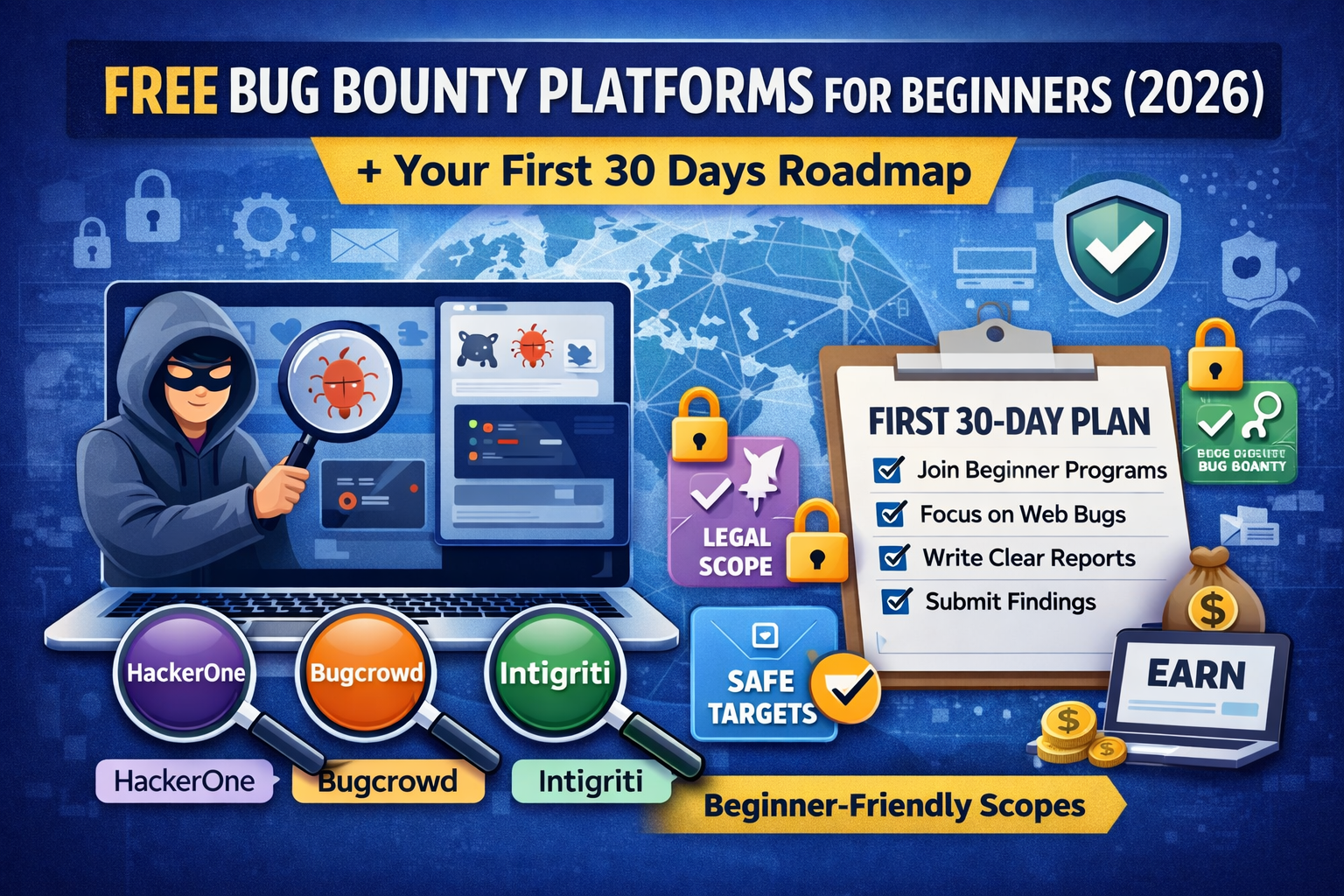
Best Free Bug Bounty Platforms for Beginners 2026: First 30 Days Roadmap
Bug bounty looks simple from the outside: find a bug, report it, get paid. In reality, beginners get stuck because they pick the wrong targets, test illegally by mistake, or submit reports that don’t match program scope. This guide fixes that.
You’ll get:
- The best free bug bounty platforms to join in 2026 (no paid tools required)
- How to pick beginner-friendly scopes that lead to valid findings
- A repeatable workflow (recon → test → report)
- A first 30-days roadmap to get your first accepted report
Important: Bug bounty is ethical hacking only when you test systems you’re explicitly allowed to test under a program’s policy and scope.
What “free bug bounty platforms” really means
Most platforms are free to join. You don’t pay to create an account, browse public programs, or submit reports. “Free” here means:
- Free access to program lists and policies
- Free account + basic features
- You can start with free tooling (browser + Burp Community + free recon)
Rewards depend on each program—some are paid bounties, others are VDP (vulnerability disclosure) with recognition only.
Best free bug bounty platforms for beginners (2026)
Below are the most beginner-friendly places to start because they have large program directories, clear scope rules, and standardized reporting workflows.
1) HackerOne (public programs + opportunities directory)
- Best for: huge program directory + public opportunities with scope details
- Where beginners win: programs with clear rules, common web app bugs, and structured triage workflows
HackerOne maintains public program listings/opportunities you can filter by type, bounty range, and asset categories.
2) Bugcrowd (VDP + bug bounty program list)
- Best for: VDP (great for first valid reports) + curated public list
- Where beginners win: disclosure programs that reward high-quality reports even if bounties vary
Bugcrowd publishes a public bug bounty/VDP list and emphasizes structured vulnerability disclosure workflows.
3) Intigriti (EU-heavy programs, clean scope rules)
- Best for: well-defined scopes, often very readable policies
- Where beginners win: web app scopes that match OWASP-style testing
(Join and focus on clearly scoped public programs.)
4) Open Bug Bounty (free disclosure for certain web vulns)
- Best for: structured disclosure (commonly XSS-focused) when a target has no formal bounty
- Where beginners win: learning clean reporting and proof without intrusive testing
The platform positions itself as a free coordinated disclosure option.
5) “Niche” platforms you can add later (after you understand scope)
- Web3-focused bug bounty platforms can be great if you’re specifically testing smart contracts and have the right skills, but they’re not always the easiest “Day-1” start. (Some 2026 lists include them, but beginners should start with web targets first.)
What to choose first (beginner scope filter that actually works)
Pick programs that are:
- Public (you can legally start immediately)
- Web app focused (easier than mobile/kernel/hardware)
- Clear “in-scope” asset list (specific domains/subdomains)
- Clear “out-of-scope” list (so you don’t waste time)
- Safe harbor language (good-faith testing protections)
Avoid at the start:
- Anything requiring DoS, heavy automation, or stress testing (usually out-of-scope)
- “Critical infrastructure” or ambiguous assets
- Programs where scope is a single massive wildcard with unclear rules
- Targets that require deep reverse engineering (save for later)
Your free beginner toolkit (legal + practical)
You can start bug bounty with free tools and still produce professional reports:
Browser setup
- Separate browser profile for testing
- Disable password autofill
- Use a clean extension set (no random add-ons)
Core testing tools
- Burp Suite Community (manual testing)
- Developer Tools (Network tab, storage, cookies)
- A notes app + screenshot tool
Recon basics (free)
- Passive recon first (no scanning)
- Read program policy, scope, and out-of-scope items carefully
The workflow that gets accepted reports (not “noise”)
Step 1: Understand scope like a triager
Before touching anything, answer:
- What exact domains are in-scope?
- Is authentication allowed? Can you create test accounts?
- Which vulnerability classes are out-of-scope?
- What evidence do they require?
Step 2: Target the “first-win” bug classes
These are common, realistic, and often rewarded:
- Broken access control (IDOR)
Change an ID in a request and see if you can access another user’s data. - Account takeover paths (weak reset, session issues)
Only if policy allows—never brute force. - Security misconfigurations
Missing security headers, sensitive data exposure, misconfigured CORS. - Stored/reflected XSS
Where policy allows, using safe proof-of-concept. - SSRF / open redirects (program-dependent)
Many programs restrict SSRF testing—read policy first.
Step 3: Prove impact safely
A report gets accepted when it shows:
- What is vulnerable
- How to reproduce (exact steps)
- What an attacker can gain
- Minimal proof that avoids harm
How to write a “triage-proof” report
Title (example)
IDOR: User can view other users’ invoices by changing invoice_id
Summary (2–3 lines)
What the bug is, where it is, and why it matters.
Affected asset
- In-scope domain:
app.example.com - Endpoint:
/api/invoices/{invoice_id}
Steps to reproduce (numbered)
- Log in with test account A
- Intercept request to
/api/invoices/12345 - Change
12345to12346(owned by account B) - Observe unauthorized invoice data returned (200 OK)
Impact
Explain what data/control is gained (privacy breach, financial fraud, account takeover path, etc.)
Evidence
- Screenshots
- Request/response snippets
- Minimal video if needed
Suggested fix (brief)
Authorization check on object ownership; use server-side access control, not client IDs.
2026 reality check: quality matters more than ever
In 2026, platforms and maintainers have been dealing with floods of low-quality reports, including AI-generated “slop,” so clean reproduction steps and real impact are critical. A recent example: the curl project publicly announced it would end its bounty program due to overwhelming low-quality submissions.
Take that as a beginner advantage: if you write clear, precise reports, you instantly stand out.
First 30 days roadmap (beginner → first valid report)
Days 1–3: Setup + policy mastery
- Create accounts on 2–3 platforms (don’t join 10 at once)
- Pick one program and read:
- scope, out-of-scope, safe harbor
- rate limits / automation rules
- Build your report template (above)
Days 4–7: Learn the target like a user
- Map the app manually:
- login, profile, settings, billing, uploads, admin areas (if permitted)
- Capture normal requests in Burp (no fuzzing yet)
- Identify ID patterns: user IDs, order IDs, invoice IDs
Days 8–12: Access control week (highest beginner ROI)
- Test for IDOR:
- change IDs in URLs, JSON bodies, GraphQL queries (if used)
- Check privilege boundaries:
- user vs user, user vs admin endpoints (only if accessible)
Days 13–16: Session & auth basics (policy-permitting)
- Logout invalidation
- Session cookie flags (Secure/HttpOnly/SameSite)
- Password reset flow logic issues (no brute force)
Days 17–20: Input handling week
- XSS in:
- profile fields, comments, tickets, filenames (where allowed)
- CORS misconfig
- Open redirect (often low severity but good practice)
Days 21–24: Sensitive data exposure
- Check responses for:
- tokens, secrets, internal URLs, debug data
- Verify impact (can it be used by an attacker?)
Days 25–27: Write 2 practice reports (even if you don’t submit)
- Take any low-risk finding (or non-impact issue) and write it like a real report.
- This builds the muscle.
Days 28–30: Submit 1–2 high-quality reports
- Only submit if:
- It’s in-scope
- You can reproduce reliably
- Impact is clear
- If you’re unsure, pick a VDP program first (lower friction, better learning loop).
Beginner FAQ
Is bug bounty legal for beginners?
Yes only when you test targets that explicitly authorize testing under a program policy and you follow scope rules.
Can I start bug bounty with no paid tools?
Yes. Many valid reports come from manual testing, basic recon, and careful analysis—not expensive tools.
What’s the fastest path to your first accepted report?
Pick one public program, focus on access control, and write a triage-friendly report with clean steps and evidence.
About The Author