Best Free AI Cybersecurity Tools for Students (2026)
Cybersecurity is no longer optional for students in 2026. Whether you are studying computer science, business, healthcare, or any non-technical field, your email, cloud storage, social media, learning portals, and financial accounts are constantly targeted by cybercriminals.
Students are especially vulnerable because attackers know that:
- passwords are reused across platforms
- security awareness is often low
- student emails receive scholarships, documents, and shared links
- many students download free tools, cracked software, or unsafe files
At the same time, cybersecurity has become more accessible than ever. Thanks to AI-assisted detection and automation, students can now protect themselves and learn cybersecurity skills using completely free tools.
Why Students Are a Major Target for Cyber Attacks in 2026
Cybercriminals do not only attack companies. Students are prime targets because their accounts provide access to:
- personal data and identity information
- institutional systems and student portals
- reused credentials that can unlock multiple platforms
- future professional email addresses
Common student-focused attacks include:
- fake scholarship and internship offers
- phishing emails pretending to be Google, Microsoft, or university IT
- malicious documents shared via email or cloud platforms
- account takeover through reused passwords
- malware hidden in “free tools” and cracked software
Because these attacks often look legitimate, AI-assisted cybersecurity tools are essential.
What “AI Cybersecurity Tools” Means for Students
When students hear “AI cybersecurity,” they often think it requires advanced knowledge. In reality, AI tools simply make security easier and faster by:
- recognizing phishing patterns automatically
- detecting malware behavior instead of relying only on signatures
- summarizing complex results in simple language
- highlighting risky actions before damage happens
You don’t need to understand machine learning. You just need to know which free tools to use and when.
The Best Free AI Cybersecurity Tools for Students (2026)
1. AI-Powered Phishing & Email Security Tools (Most Important)
Email is the number one attack vector for students. Most account compromises start with a single phishing email.
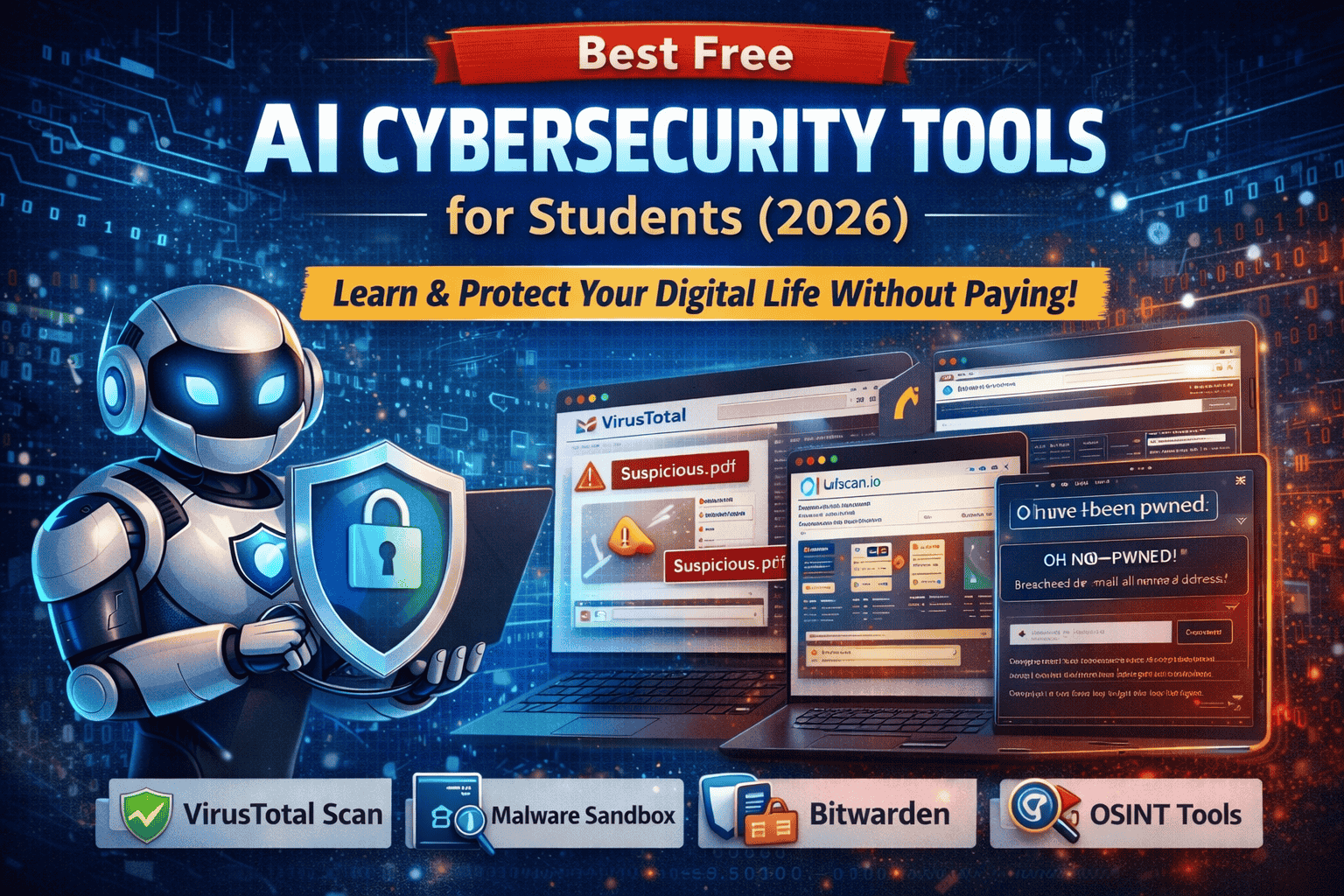
VirusTotal (Free Tier)
VirusTotal is one of the most powerful free security tools available to students. It analyzes links and files using multiple security engines and AI-based reputation systems.
Students should use VirusTotal whenever they:
- receive a suspicious email link
- receive an unexpected attachment
- download a tool from an unfamiliar website
Instead of clicking, students should copy the link and scan it. This simple habit alone prevents most phishing attacks.
urlscan.io (Free)
urlscan allows students to preview a website without visiting it directly. It safely loads the page and shows:
- screenshots
- redirect chains
- loaded scripts
- suspicious behaviors
This is especially useful for detecting fake login pages that imitate Google, Microsoft, or university portals.
2. AI-Assisted Malware Analysis Tools
Students often download files from the internet, which makes malware a serious risk.
ANY.RUN / Hybrid Analysis (Free Tiers)
These sandbox tools allow students to upload suspicious files and see what they do in a safe cloud environment.
Instead of guessing whether a file is dangerous, students can observe:
- process execution
- network connections
- dropped files
- credential-stealing attempts
This is extremely valuable for students learning cybersecurity or responding to suspicious downloads.
Built-In OS Security (Windows Defender / macOS Gatekeeper)
Many students disable built-in security features to run cracked software, which is a major mistake.
Modern built-in protections use machine learning and behavioral detection. Keeping them enabled dramatically reduces risk.
3. Password & Account Security Tools
Password reuse is the leading cause of student account compromise.
Bitwarden (Free Password Manager)
Bitwarden allows students to:
- generate strong, unique passwords
- store credentials securely
- avoid password reuse
Using a password manager combined with 2-factor authentication is the single most effective security improvement students can make.
Have I Been Pwned (Free)
This service checks whether your email has appeared in known data breaches.
Students should regularly check:
- primary email address
- old email accounts
- frequently used usernames
If breached, passwords must be changed immediately.
4. OSINT & Personal Exposure Tools
Students often unknowingly expose personal information online.
By searching their own names, emails, and usernames, students can:
- discover leaked documents
- remove exposed resumes or IDs
- understand how attackers collect data
This awareness helps prevent identity theft and targeted phishing.
5. Learning & Skill-Building Platforms
Cybersecurity skills should be learned legally.
Free platforms like TryHackMe and PortSwigger Web Security Academy provide:
- structured learning paths
- hands-on labs
- safe environments
These platforms use AI-assisted guidance and are ideal for beginners.
A Complete Student Cybersecurity Setup
Step 1: Secure Your Main Email
Your email controls everything else.
- enable 2-factor authentication
- remove unknown connected apps
- review security activity
Step 2: Fix Password Habits
Install a password manager and update passwords for:
- social media
- cloud storage
- financial apps
Step 3: Build a Safe Clicking Habit
Never click unknown links directly.
Always:
- scan links with VirusTotal
- preview pages with urlscan
Step 4: Protect Your Device
- keep OS security enabled
- avoid cracked software
- sandbox suspicious files
Step 5: Start Learning Cybersecurity
Practice on legal platforms to build real skills without risk.
Common Student Cyber Scams in 2026
Students should be especially cautious of:
- scholarship scams
- fake job offers
- “document shared” phishing
- fake IT support emails
- social media account recovery scams
These scams rely on urgency and trust.
Why Free AI Cybersecurity Tools Are Enough for Students
Students do not need enterprise security software. Free tools are sufficient because:
- AI detection improves accuracy
- sandboxes remove execution risk
- password managers stop credential theft
- awareness prevents social engineering
Consistency matters more than complexity.
FAQs
What is the best free AI cybersecurity tool for students?
VirusTotal for links/files and Bitwarden for passwords are the most important starting tools.
Can students learn cybersecurity without paying?
Yes. Many high-quality platforms and tools are completely free.
Are AI security tools safe to use?
Yes, as long as students avoid uploading sensitive personal files.
About The Author