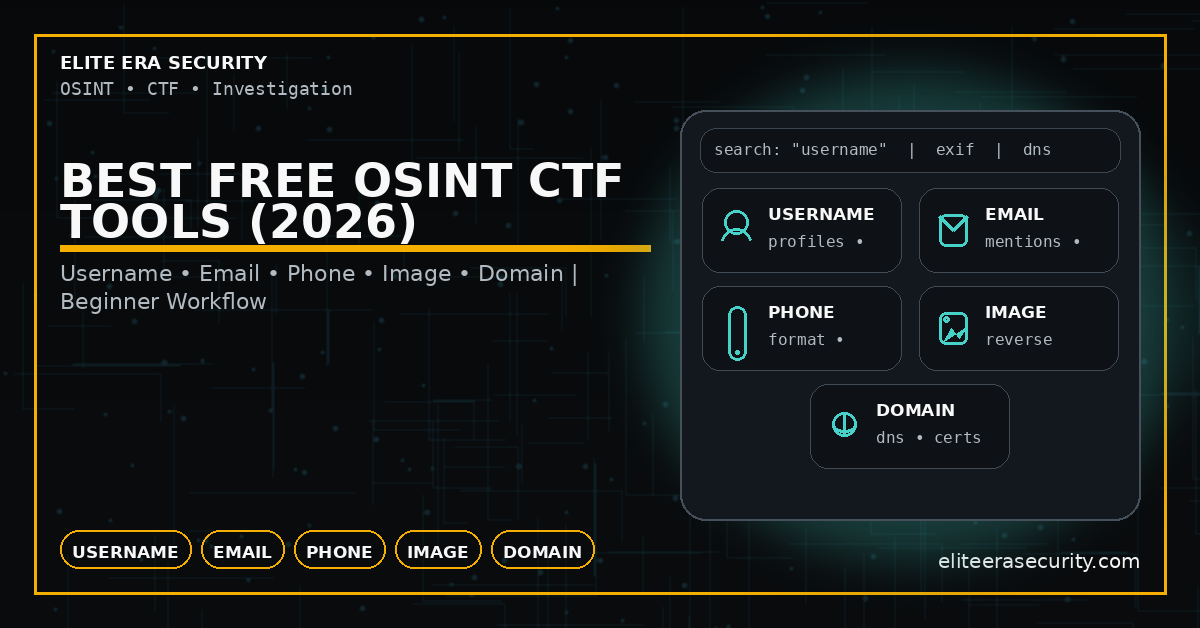
OSINT CTF tools are free tools and techniques used to discover useful information from public data: social media footprints, usernames, leaked public profiles, domain records, images and metadata, exposed documents, and publicly indexed pages. In CTF challenges, you’re usually given a small clue like a username, a picture, an email, or a domain and your goal is to find the hidden flag by connecting evidence.
OSINT (Open Source Intelligence) is one of the most powerful skills in cybersecurity because it teaches you how attackers and investigators find information using public sources. In 2026, OSINT is used everywhere from account recovery and fraud detection to threat intelligence and incident response. That’s why OSINT CTF challenges are so valuable: they train you to follow clues, verify evidence, and build a repeatable investigation workflow without needing advanced exploitation.
The reason OSINT CTF is beginner-friendly is that it doesn’t require “hacking” systems. It requires something more valuable: thinking clearly. You learn how to search intelligently, confirm facts from multiple sources, and avoid jumping to conclusions.
The Best Beginner OSINT Workflow
Before you use any tool, follow a simple structure. OSINT becomes easy when you stop “random searching” and start following a process.
- Understand the clue: username? email? phone? image? domain?
- Search wide first: Google-style search, social platforms, public indexes.
- Narrow down: collect matching profiles, links, aliases, and patterns.
- Verify: confirm using 2–3 independent signals (bio links, matching photos, same usernames, same writing style).
- Extract the flag: many CTF flags are hidden in a paste, a repo, a comment, metadata, or a public file.
- Document your chain: keep notes/screenshots so you can reproduce.
This workflow is how professionals do OSINT, not just CTF players.
1) Best Free Username OSINT Tools
Usernames are the most common starting clue in OSINT CTF challenges. The goal is to find where the username exists online, then identify the most relevant profiles and clues connected to it. In 2026, most people reuse usernames across platforms, which creates a searchable footprint.
What to do with a username (fast method)
- Search the exact username in quotes:
"username123" - Try variations:
username_123,username1234,user.name - Look for profile pages, bios, links, and reposted content
- Check developer platforms (often used in CTF clues)
Free tools you can use
- Sherlock (open-source): checks many sites for username existence
- Namechk / Namecheck-style sites: quick username availability checks
- Google dorks for username (legal/public only):
"username" site:github.com"username" site:pastebin.com"username" site:reddit.com
OSINT tip: In CTFs, the “flag” is often inside a bio link, a public paste, a GitHub repo README, or an old comment.
2) Best Free Email OSINT Tools
Email clues appear in OSINT CTFs when the challenge wants you to pivot into accounts, profiles, or public leaks. The ethical rule matters here: you only use public/legal sources and the CTF’s intended scope.
How email helps in OSINT CTF
An email can reveal:
- linked accounts (through public profiles)
- Gravatar / profile images (if enabled)
- mentions in public documents or web pages
- public breach exposure hints (for awareness)
Free email OSINT tools
- Have I Been Pwned (HIBP): check if email appears in known breaches (awareness use)
- Gravatar check: sometimes a profile image is attached publicly
- Search operators:
"email@example.com""email@example.com" filetype:pdf"email@example.com" site:github.com
In CTFs, email OSINT is usually used to find a publicly posted clue—like a leaked note, a public doc, or an account profile.
3) Best Free Phone OSINT Tools
Phone-number OSINT is commonly included in scam-awareness CTFs or identity tracing challenges. It must be handled ethically and legally. In CTFs, phone clues are usually used to find the location context, service provider hints, or public posting patterns.
What phone OSINT can reveal in CTFs
- country/region format hints
- public listings in posts or social pages (when intentionally placed)
- associated usernames in public content (sometimes)
Free phone OSINT resources (CTF safe)
- Search the phone in quotes:
"+1 555 123 4567" - Use platform search: social media or forums (public only)
- Regional pattern recognition: country codes, spacing, formatting clues
Avoid tools that claim “private data access.” Real OSINT relies on legal, publicly available sources.
4) Best Free Image OSINT Tools
Images are extremely common in OSINT CTF challenges because they can hide clues in metadata, backgrounds, reflections, signs, or even file structure. In 2026, image OSINT is also crucial for scam detection and misinformation analysis.
Image OSINT checklist (fast)
- Reverse image search to find where it was posted
- Check EXIF metadata (camera, GPS if present)
- Zoom and inspect background clues (street signs, logos, landmarks)
- Check if the image is edited or contains hidden layers
Free tools for image OSINT
- Google Lens / reverse image search
- TinEye (reverse image search)
- ExifTool (metadata extraction)
- Online EXIF viewers (fast beginner method)
CTF tip: Many flags hide in EXIF “comment” fields, filenames, or a linked page where the image was posted.
5) Best Free Domain OSINT Tools
Domains are high-value OSINT targets because they connect services, infrastructure, and ownership signals. In OSINT CTFs, a domain clue usually means you should check DNS records, certificate logs, and public pages.
What to check first with a domain
- Is there a website? What pages exist?
- DNS records (A, AAAA, MX, TXT)
- Subdomains (often contain hidden portals)
- SSL certificate transparency records (often reveal subdomains)
- Past versions of pages (archives)
Free domain OSINT tools
- WHOIS lookup (registration info if public)
- DNS lookup tools (A/MX/TXT records)
- Certificate Transparency logs (subdomain discovery)
- Wayback Machine-style archives (older pages)
In CTFs, the flag is often placed on a forgotten subdomain, a hidden /admin page, an old archived page, or a TXT record hint.
Common OSINT CTF Mistakes And How to Avoid Them
Beginners usually lose time by searching randomly and trusting the first result. OSINT is about verification, not speed. The fastest OSINT players are those who confirm clues before committing.
Avoid these:
- trusting one signal (always verify with at least two)
- ignoring small details (time zones, spelling, formatting)
- skipping metadata checks
- not saving links and notes
- falling for “fake OSINT tools” that promise private data
OSINT CTF Checklist (2026)
- Identify clue type: username / email / phone / image / domain
- Search exact match in quotes + common variations
- Pivot using reliable signals (bio links, repos, posts, metadata)
- Use reverse image + EXIF metadata for pictures
- For domains: DNS + certificates + archives + subdomains
- Verify findings with 2–3 independent matches
- Document steps to reproduce the flag
FAQs
Is OSINT legal?
Yes OSINT means using publicly available information. In CTFs and training, always follow the scope and rules.
What is the best OSINT tool for beginners?
For beginners, start with: search operators, reverse image search, and basic domain lookups. The workflow matters more than the tool.
Can OSINT be used for cybersecurity jobs?
Yes. OSINT is used in threat intelligence, SOC analysis, incident response, fraud detection, and brand protection.
Why do OSINT CTF challenges feel confusing?
Because the clue is small and you must “pivot.” Use a structured workflow and verify your assumptions.
About The Author