Best Free Bug Bounty Certificates
When people search “free bug bounty certificate”, they usually want one thing: a credential that looks real on a CV and makes employers trust them faster. The problem is that bug bounty doesn’t work like many other fields. There are very few truly “free certificates” that recruiters treat like formal certifications. What hiring teams respect most is verifiable proof that someone can find vulnerabilities, write clean reports, and follow ethical rules.
That’s why the smartest approach in 2026 is to focus on internship-style credentials: trusted learning platforms, public progress proof, and profiles that show real outcomes. This guide explains what is legit vs scam, what recruiters actually respect, and the best free ways to build proof without using paid tools.
The Truth About “Bug Bounty Certificates” in 2026
Bug bounty is performance-based. Companies pay for valid findings, so credibility comes from evidence, not from a fancy PDF. A “certificate” only becomes valuable when it is backed by one of these:
- A recognized issuer with a reputation in security
- A verification method (badge link, credential ID, public profile)
- Clear proof of work (labs completed, write-ups, accepted reports)
Free bug bounty certificates are rare, but free proof-of-work paths are everywhere and those are what recruiters use to judge beginners.
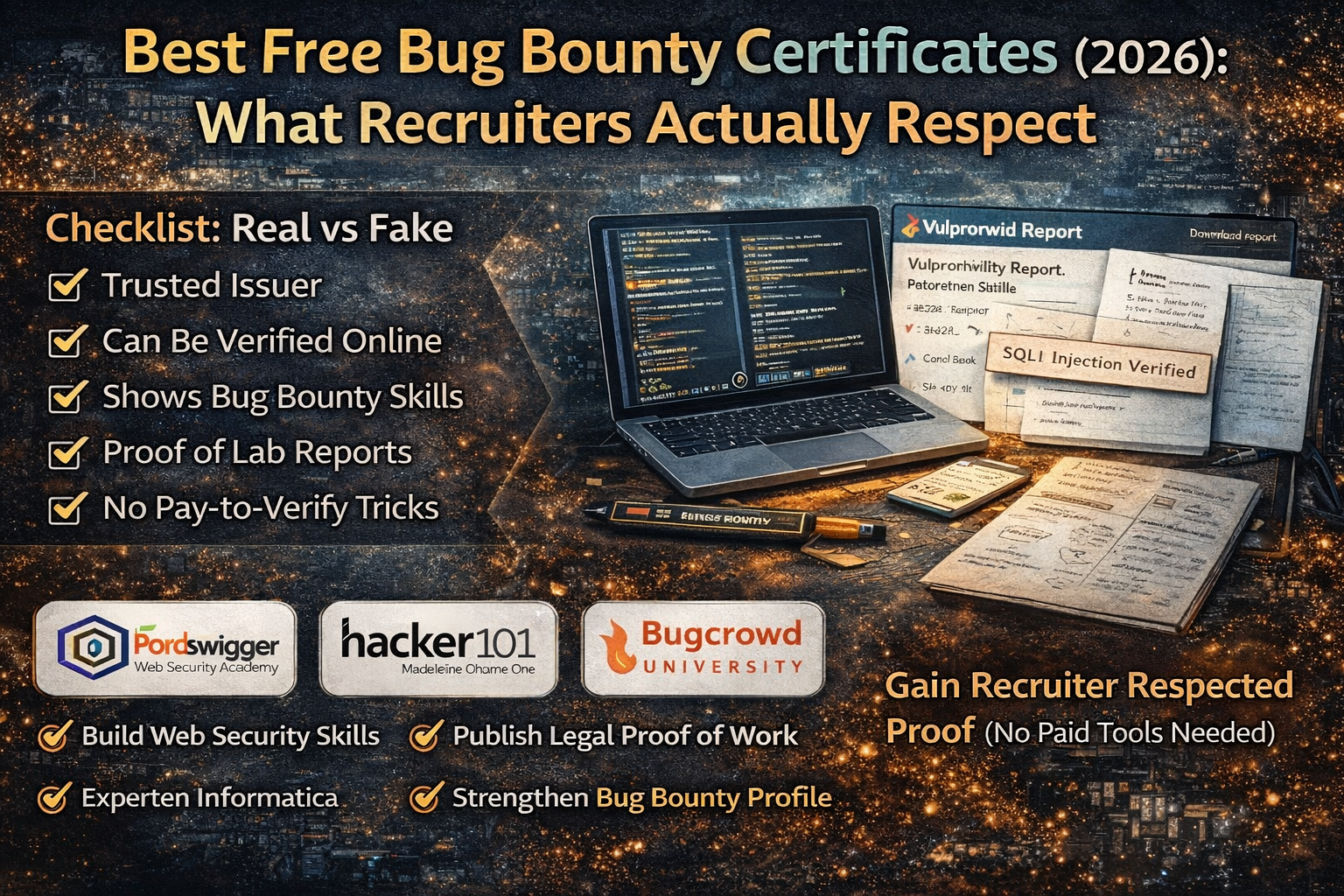
Real vs Fake: The Bug Bounty Certificate Checklist
A bug bounty certificate is usually worth listing if it passes most of these checks:
1) The issuer is recognized in security
If the certificate is from a known organization in web security or bug bounty learning, it carries more weight. If it’s from a random site with no real reputation, it’s usually ignored.
2) It can be verified online
A strong credential has a public verification method such as:
- A certificate link with a unique ID, or
- A digital badge page, or
- A recognized platform profile that shows activity
For example, PortSwigger’s certification explains that successful candidates receive a certificate link with a unique identifier and defined validity dates.
3) It reflects skills that match bug bounty work
Bug bounty is mostly web security. If a credential is unrelated or too generic, it won’t help much.
4) There is real work attached to it
Recruiters trust people who can show what they practiced: labs, write-ups, report samples (sanitized), or verified platform progress.
5) No “pay to verify” tricks
If a “free certificate” requires a payment to verify, unlock, or download, it’s a red flag.
What Recruiters Actually Respect in Bug Bounty
In real hiring, the strongest “bug bounty credential” signals usually look like this:
A) A public bug bounty profile with proof of participation
Recruiters respect platforms and communities because they reflect real-world workflows: following scope, reporting clearly, and communicating professionally. Even without paid certifications, an active profile and documented learning can show seriousness.
Bugcrowd, for example, allows researchers to build a resume inside the platform that includes sections like security testing and certifications, and it’s used as supporting evidence for program applications.
B) Hands-on web security labs from a trusted source
PortSwigger’s Web Security Academy is a free training center for web application security and includes practical labs across major vulnerability categories.
C) A clean proof-of-work portfolio
A simple “proof” page with 5–10 short write-ups often impresses more than a fake certificate. The goal is not showing exploits on real targets. The goal is showing that web security concepts were understood and practiced in legal labs.
Best Free Bug Bounty Learning That Functions Like a “Certificate”
These options are free and give the exact kind of outcome hiring teams trust: practical web security skills and public proof.
1) PortSwigger Web Security Academy (Free Labs) — Best Bug Bounty Skill Builder
PortSwigger’s Web Security Academy is a free online training center for web app security and includes interactive labs for topics like SQL injection, XSS, CSRF, access control, and many more.
This is as close as most beginners get to “internship-level” practice without paying. It trains the exact thinking bug bounty requires: test a behavior, confirm the vulnerability in a safe lab, and understand the impact and prevention.
What counts as “proof” here
- A list of completed labs
- 5 short write-ups (one per vulnerability type)
- A final “learning report” summarizing what was practiced
PortSwigger also offers a respected certification (Burp Suite Certified Practitioner), but the exam is not free. It is still worth mentioning because it explains certificate verification and unique IDs, which is what “real credentials” look like.
2) Hacker101 (Free) + Hacker101 CTF (Free) — Best Beginner-Friendly Bug Bounty Training
Hacker101 is described as HackerOne’s free web security training initiative, offering free video lessons, written guides, and a CTF designed to teach practical hacking skills.
For common learners, this is powerful because it feels structured and safe. It helps build a foundation in web security concepts and gives practice through CTF-style challenges. Even without a “certificate,” completing a sequence of lessons and CTF progress becomes a strong portfolio story.
What counts as “proof” here
- A public learning log: lessons covered + key takeaways
- 3 CTF reflections: what was learned and what skill improved (no spoilers needed)
3) Bugcrowd University (Free) — Best “Bug Bounty World” Introduction
Bugcrowd University is presented as a free way to begin learning bug bounty basics and ethical hacking concepts.
This is valuable because it introduces bug bounty culture: responsible behavior, scope mindset, safe reporting, and learning flow. It’s also connected to the broader bug bounty ecosystem, which adds credibility.
What counts as “proof” here
- A structured summary of completed learning modules
- A personal “rules of engagement” checklist (ethical scope mindset)
- A short report template (how findings would be written clearly)
“Free Bug Bounty Certificates” That Recruiters Ignore
These patterns are extremely common online and usually harm trust:
- Instant “Bug Bounty Expert Certificate” PDFs with no verification
- Certificates that promise job guarantees or “become a hacker in 3 hours”
- Sites that use fear tactics and upsells
- Certificates that require payment to “verify” later
If a credential can’t be verified and has no real issuer reputation, it usually won’t help with hiring.
The Best “Recruiter-Respected” Bug Bounty Proof Plan (Free)
A strong beginner can build a credible bug bounty profile without paying by following a simple structure that produces real evidence.
Step 1: Build web security fundamentals with trusted free content
Use Hacker101 for beginner web security lessons and a CTF practice routine.
Step 2: Do hands-on labs like an intern
Use PortSwigger Web Security Academy labs across major categories (SQLi, XSS, auth, access control, etc.).
Step 3: Publish proof-of-work (safe and legal)
Create 5–10 beginner write-ups based on labs. Each write-up should explain:
- what the vulnerability is
- what the lab demonstrated
- real-world impact in simple words
- prevention at a high level
Step 4: Keep a bug bounty resume profile ready
Bugcrowd supports building a resume inside the platform that includes security testing and certifications, and it helps support program applications.
This creates a credible “bug bounty story” without relying on questionable certificates.
FAQ
Are there truly free bug bounty certifications?
Very few. Most respected certifications involve a paid exam. The best free alternative is building verifiable proof-of-work through trusted labs and training platforms.
What matters more than a certificate for bug bounty?
Hands-on labs + clean write-ups + a strong platform profile. That combination often beats a pile of unverified PDFs.
What’s the safest way to practice bug bounty legally?
Use dedicated training labs and CTF platforms designed for safe learning, like PortSwigger Web Security Academy and Hacker101 CTF.
About The Author