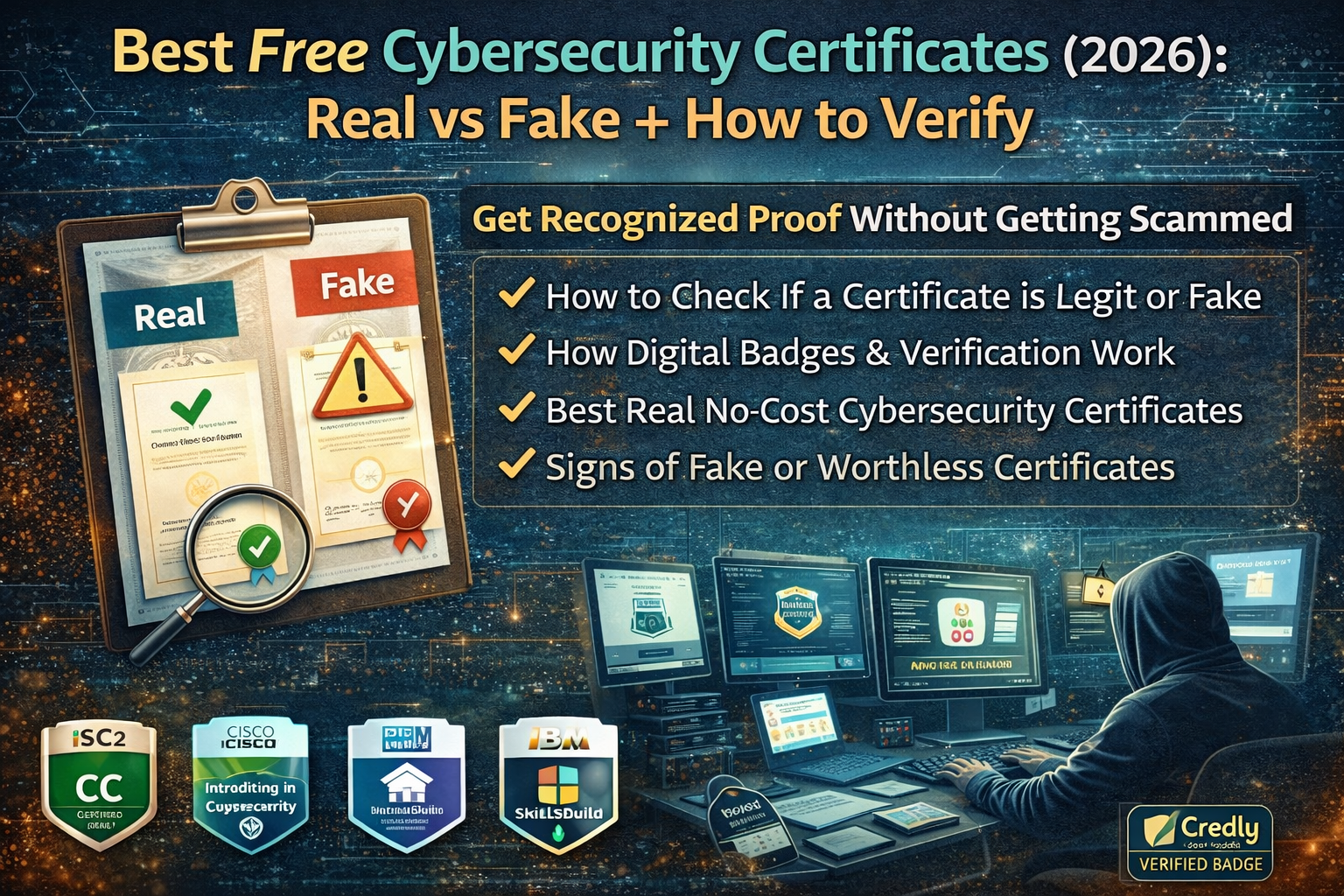
Best Free Cybersecurity Certificates (2026): Real vs Fake and How to Verify
When a normal person searches “free cybersecurity certificate”, they’re usually not trying to become a hacker overnight. They want something simple and practical: a safe way to learn cybersecurity, a certificate they can show on LinkedIn or a CV, and confidence that they’re not wasting time on a fake “PDF certificate” that nobody respects.
The truth is: in 2026, “free certificates” are everywhere but not all certificates are equal. Some are issued by trusted global organizations and can be verified online. Others are just fancy-looking downloads that don’t prove anything. This guide makes it easy for beginners: you’ll learn the real vs fake difference, how verification works in real life, and which free (or genuinely no-cost) certificates are worth pursuing.
What “Free Cybersecurity Certificate” Really Means in 2026
Most free certificates fall into one of these three categories. Once you understand this, you’ll stop getting confused by marketing.
1) Free training + free exam (rare, highest credibility)
This is the strongest type because it’s closest to a real certification experience. You study, you take an official exam, and you earn a credential that employers recognize. These offers are limited and not always available year-round, but when they exist, they are the best “free certificate” option.
2) Free training + verified digital badge (common, very useful)
This is the most realistic “free credential” most beginners will earn. You complete a structured course from a known company (like Cisco, IBM, or Microsoft learning ecosystem). After completion, you receive a digital badge or credential with a public verification page. It’s not the same as a proctored certification exam, but it is still real proof of learning—especially when it’s verifiable.
3) Instant PDF certificate (low trust)
These are the ones that look fancy but don’t help much. If a website lets you type your name and instantly generate a “certificate” without structured training, assessment, or verification, employers typically don’t value it. Some of these sites are also risky because they can collect your data or push upsells later.
Real vs Fake: The Simple Verification Checklist Beginners Can Use
Before you add any certificate to your CV, run these checks. This section alone can save you hours.
Check 1: Is the issuer real and recognizable?
A legit certificate comes from an organization that clearly exists, has a real reputation, and maintains official pages explaining the program. If the certificate is from a random site with no recognized organization behind it, it’s usually weak.
Check 2: Can someone verify it online in one click?
This is the biggest difference between “real” and “fake.”
A real certificate often has:
- a badge link (public verification page), or
- a credential portal where the credential can be validated.
If there’s no verification and it’s just a downloadable PDF, it’s much less credible.
Check 3: Does it clearly say what you learned or proved?
A respected credential describes:
- what topics it covers,
- what you had to do (course, quiz, assessment, lab tasks),
- and what the certificate represents.
If the certificate uses vague words like “Master Hacker” or “Certified Cyber Expert” without explaining what was assessed, it’s a red flag.
Check 4: Does it try to charge money to “verify”?
A common scam pattern is: “Free certificate” → then a “verification fee” or “shipping fee” appears. Trusted programs don’t work like that. If the only way to “activate” or “validate” the certificate is paying an unknown website, treat it as suspicious.
Check 5: Does the program sound realistic?
If a certificate claims you’ll become job-ready in one day, or promises a guaranteed job, or uses heavy hype language, it’s usually marketing—not a credential.
Best Free Cybersecurity Certificates (2026) That Are Actually Worth It
Below are beginner-friendly options that are widely seen as legitimate because they come from known issuers and typically include verification (or are tied to a major credential ecosystem). Availability can change, but the key point is: these options are real learning milestones, not random PDFs.
1) ISC2 “Certified in Cybersecurity (CC)” free training + exam offer (when available)
For beginners, this is one of the strongest “free certificate” opportunities because it comes from a major security certification organization. When the free exam offer is available, it gives you something closer to a traditional certification path: structured learning + exam.
For a common person, the biggest value is that it doesn’t feel like a “social media certificate.” It’s a credible foundation credential that signals: “I learned security basics in a formal way, and I passed an assessment.”
2) Cisco Networking Academy cybersecurity badges (verifiable)
Cisco’s learning paths are popular because they’re structured, beginner-friendly, and often provide shareable badge-style credentials. For a normal reader who wants to start without confusion, Cisco-style learning is attractive because it follows a clear sequence and uses practical concepts that connect to real jobs.
These badges are especially useful if you’re building a LinkedIn profile. A verifiable badge is simple proof that you completed a real course from a globally recognized company.
3) IBM SkillsBuild cybersecurity credentials
IBM’s learning ecosystem is another strong option for beginners who want credible training and shareable credentials. For common people, IBM-style credentials matter because they’re not just “learning videos”—they are positioned as skills development with proof you can show publicly.
IBM credentials can be valuable in entry-level job applications because they reflect structured learning milestones from a globally recognized company.
4) Microsoft’s credentials ecosystem (Applied Skills / learning-based credentials)
Microsoft’s learning ecosystem is huge, and Microsoft-issued credentials tend to be trusted because they are tied to a formal credential system. For common people, this is helpful because it feels professional: the credential is linked to the issuer, and it’s easy to share in a standardized way.
This category is especially useful for people who want to move toward cloud/security roles later (because Microsoft learning often connects naturally to job paths).
What Recruiters Actually Trust When You’re a Beginner
For entry-level cybersecurity, most recruiters don’t expect you to have advanced paid certifications immediately. But they do look for signals of seriousness and proof you can learn and apply skills.
That’s why the highest-trust combination is always:
- A verifiable credential (badge/certificate from a known issuer)
- A small proof of work (even simple)
A proof of work can be as basic as:
- a short write-up of what you learned (one page)
- screenshots of labs you completed
- a small “Beginner Portfolio” page with 3–5 items
When a recruiter sees a verifiable credential plus proof-of-work, it tells them you didn’t just collect certificates—you learned something and applied it.
The Best Free Certificate Path for Common People (Simple, Clean, Not Overwhelming)
If you’re starting from zero, the best approach is to build a small stack that makes sense:
Step 1: Get one strong foundation credential
Start with a beginner-friendly credential from a known issuer. If an exam-based free offer is available, it’s a strong choice. If not, start with a verified badge program from a trusted company.
This first step gives you confidence and a “start line” you can show publicly.
Step 2: Add one practical credential that looks job-relevant
After your foundation, add a second credential from a major vendor ecosystem. This makes your profile look more serious because you’re not depending on one course only.
For common people, two solid credentials from known issuers is often better than ten random PDFs.
Step 3: Support it with one small proof-of-work
Even one simple lab write-up can separate you from thousands of people who only list certificates. Proof-of-work also makes your learning feel real—because you can show what you did, not just what you watched.
Fake “Free Certificates” to Avoid (Common Traps)
These patterns show up again and again:
- “Certified Ethical Hacker in 2 hours” style promises
- “Government approved / internationally accredited” with no real accreditor you can verify
- No issuer reputation, no official credential page
- A certificate you can download instantly without any course structure
- Hidden “verification fee” after claiming it’s free
- Sites that push risky downloads or “hacking tools” as part of the certificate
If a certificate tries to make cybersecurity look like a shortcut, it’s usually not a serious credential.
FAQ
Are free cybersecurity certificates actually worth it?
Yes—if they are verifiable and issuer-backed. For beginners, a credible free badge or certificate can be a strong first step, especially when you pair it with a small proof-of-work.
What’s better: a free badge or a fake-looking “official” PDF?
A verifiable badge from a known issuer is usually far stronger than a fancy PDF that cannot be validated.
Can a free certificate get me a job?
A certificate alone usually won’t. But a verifiable certificate plus proof-of-work can absolutely help you get interviews, internships, and entry-level opportunities.
About The Author