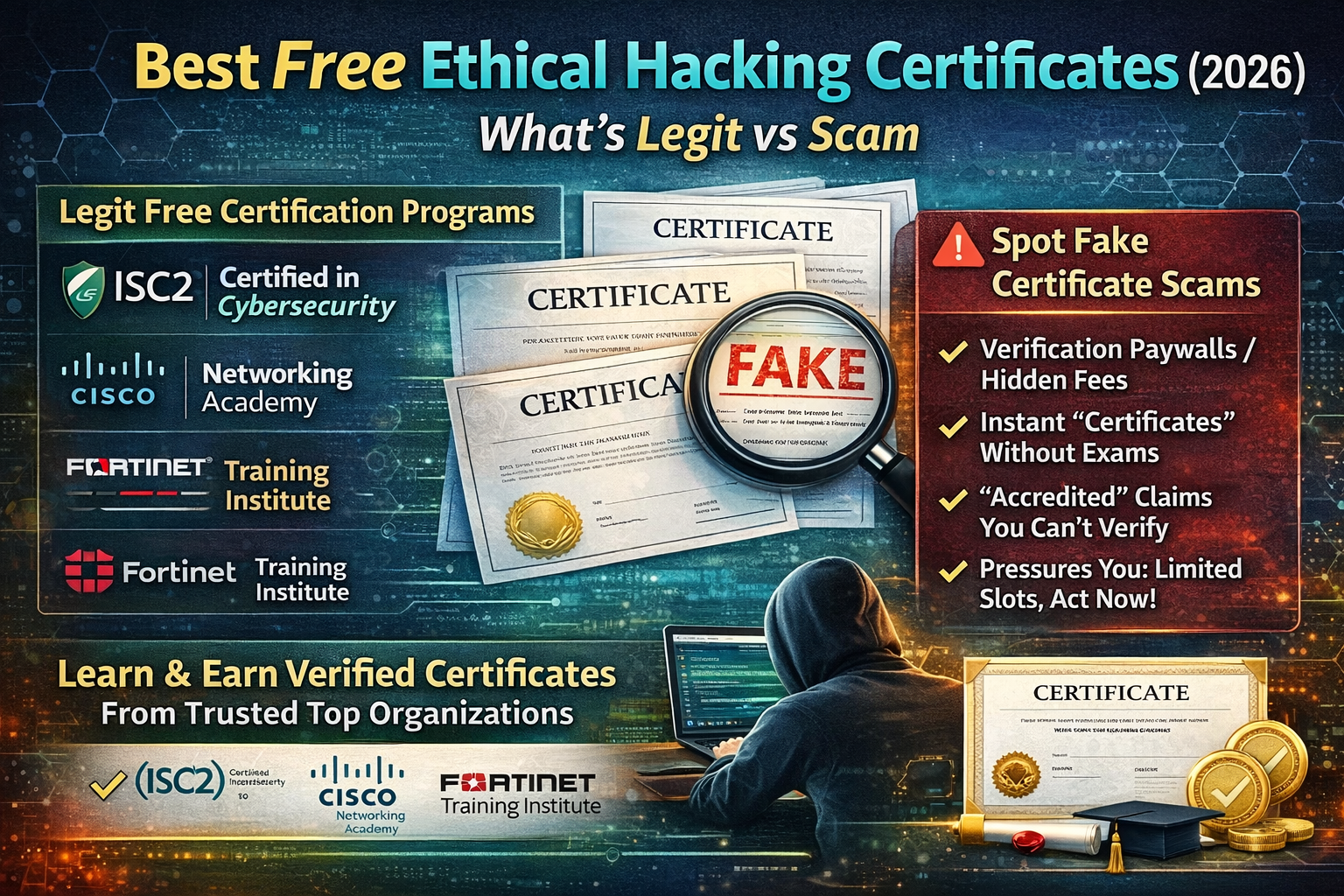
Best Free Ethical Hacking Certificates 2026: What’s Legit vs Scam
People search “free ethical hacking certificate” because they want a real credential they can put on LinkedIn, include in a CV, and use to prove skills—without paying hundreds of dollars. The problem is that the internet is full of “free certificates” that look impressive but don’t mean anything, and some are simply scams designed to collect personal data, push shady downloads, or sell “verification fees” later.
A clean way to avoid confusion is to separate “free certificates” into three categories:
- Truly free certification offers (training + exam offered free by a recognized organization)
- Free training with a badge/certificate of completion (useful for learning and portfolio-building, but not always an industry certification)
- Fake or misleading certificate claims (the ones that waste time, money, or create risk)
This guide focuses on ethical hacking and practical cybersecurity certificates that are widely recognized, with a clear explanation of what each one actually is.
What Counts as a “Legit” Free Certificate in 2026
A legitimate free certificate typically has at least a few strong signals: a clear issuing organization with a public reputation, transparent requirements, and a verification method (digital badge platform, certificate ID, or official record). The issuer’s website usually describes exactly what the credential represents—whether it’s a training completion certificate, a skills badge, or a formal certification exam outcome.
A scam certificate usually behaves differently. It leans heavily on hype words (“internationally accredited,” “government approved,” “guaranteed job,” “lifetime valid”) but stays vague about who issues it, how the exam is proctored (if at all), and how verification works. If the “certificate” is instantly generated without any learning, assessment, or identity checks, it may look nice but has little credibility.
The Best Truly Free Certification Offers (Training + Exam)
1) ISC2 Certified in Cybersecurity (CC) – Free training + free exam offer (when available)
One of the most important real “free certification” opportunities in recent years has been the ISC2 initiative offering free online self-paced training and free exams for their entry-level Certified in Cybersecurity (CC) credential, designed to widen access to cybersecurity careers.
This is not positioned as an “ethical hacking-only” credential. It’s better understood as a foundation certificate that helps beginners prove they understand core security concepts. For many readers, that’s exactly what makes it useful: it’s a recognized organization, the credential is standardized, and it can serve as a clean starting point before moving into specialized tracks.
Best Free Training That Gives Legit Certificates/Badges (Not Always a Free Exam)
2) Cisco Networking Academy – Free courses + digital badges
Cisco Networking Academy offers free, self-paced courses and is commonly used as a starting point for networking and cybersecurity learning. It also connects learning paths to digital badges and preparation for industry certifications.
This matters because many people confuse “free course completion” with “free certification exam.” Networking Academy is valuable because it’s a known brand and the learning is structured, but in many cases the industry certification exams themselves are separate. Even when the exam is not free, the training still has real value because it produces credible learning outcomes and evidence of progress.
3) Fortinet Training Institute – Free self-paced training (cert path depends on level)
Fortinet provides a large amount of training that is free and self-paced, and their certification ecosystem (formerly NSE, now Fortinet Certification Program) is widely referenced in security learning paths.
The key point for readers is that “free” often applies to the training access, while hands-on lab access or certification exam attempts can vary by program and level. As a result, Fortinet is best understood as a strong free learning and portfolio option, with the added benefit that it comes from a respected security vendor and is aligned with real-world enterprise security concepts.
4) EC-Council “Learning” free courses + certificates of validation (completion-style)
EC-Council has promoted free courses that provide certificates of validation for completion.
For common-person readers, this kind of credential is best treated as a training completion proof rather than a deep “exam-based professional certification.” It can still help build confidence and show learning progress, but it should be framed realistically: hiring managers typically value well-known proctored certifications and demonstrable lab skills more than instant completion documents.
Popular “Free” Certificates That Are Often Misunderstood
Google Career Certificates Cybersecurity Certificate – high quality, but usually paid (financial aid exists)
The Google Career Certificates Cybersecurity Certificate is widely known and has strong brand recognition. Official pages describe it as a career-focused program designed to prepare learners for entry-level roles.
However, people frequently label it “free” because the platform may allow “enroll for free” in a trial sense or offer financial aid in some cases, while the full certificate path is often paid through the course platform. This doesn’t make it bad—it makes it important to describe honestly. It can be a great option for skill-building, but it should not be promoted as “guaranteed free certificate” unless the certificate is confirmed free at the time someone enrolls.
What’s Real vs Fake: The Difference People Miss
Real: “Verified, issuers you can check”
A real certificate or badge tends to come from:
- a known organization (major vendor, university, recognized certification body),
- a consistent curriculum and assessment model,
- a verification method that can be checked independently.
That’s why offerings from ISC2, Cisco, and Fortinet tend to be trusted: their official pages clearly describe training/certification structure and what “free” applies to.
Fake: “Certificate mills” and misleading certificate ads
Fake certificate offers commonly show patterns like:
- “free certificate” but later requires a verification fee or “shipping fee”
- “accredited by” claims without an accrediting body that can be confirmed
- no clear issuer address, no official domain reputation, and no verification mechanism
- certificates generated instantly without a course or assessment
- pressure tactics: “limited seats,” “last chance,” “act now,” while still vague about details
Many scammers also use “ethical hacking” wording because it attracts beginners quickly. A suspicious certificate advertisement often promises access to tools that cross legal lines, or implies hacking real accounts or social media—signals that the program is not education-focused.
Best Free Ethical Hacking Certificates (2026): The Most Honest Shortlist
To keep this practical and realistic for your readers, here is the best “common person” shortlist with clear expectations:
Best truly free (when active)
- ISC2 Certified in Cybersecurity (CC) — free training + free exam offer (subject to availability/eligibility)
Best free training + credible badges/certificates (great for CV proof)
- Cisco Networking Academy — free self-paced courses, digital badges, strong learning structure
- Fortinet Training Institute — free self-paced training; certification structure depends on program level
- EC-Council free courses with certificates of validation — completion proof, best used as a learning milestone
Best brand-recognized program often mistaken as “free”
- Google Career Certificates Cybersecurity Certificate — strong for learning; pricing/aid depends on platform terms at the time
What Makes a Free Certificate Valuable for Jobs
For most entry-level cybersecurity and ethical hacking roles, the certificate itself is only one part of credibility. The best certificates are valuable when they connect to proof of skills: labs completed, projects documented, or measurable learning outcomes.
That’s why completion certificates from reputable issuers still matter: they provide structure, discipline, and a paper trail. On the other hand, “instant certificates” from unknown sites often add little because they don’t demonstrate time investment or real assessment.
A strong free certificate path usually pairs naturally with: home labs, CTF practice, writeups, and a simple portfolio page that shows what was learned and applied. When those pieces exist, even a “free badge” becomes meaningful because it sits inside visible work.
FAQs
Are there any truly free ethical hacking certifications?
Some reputable organizations run programs that include free training and free exam offers, such as ISC2 Certified in Cybersecurity (CC) (availability and terms can change).
Why do so many “free certificates” feel fake?
Because many are marketing funnels or certificate mills that skip real assessment and later push hidden fees. Legit programs clearly explain issuer identity, assessment, and verification.
Do free course certificates help on LinkedIn?
They can, especially when the issuer is recognized (major vendors and respected orgs), and when the profile also shows projects or labs that prove applied skills.
About The Author