Best Free Ethical Hacking Courses (2026): The Only List You Need to Learn Legally, Practically, and Fast
“Ethical hacking” isn’t about running random tools. It’s about understanding how systems work, how they break, and how to test them with permission. The best free courses in 2026 are the ones that combine clear explanations + hands-on labs and build the exact skills recruiters expect: web security basics, Linux + networking fundamentals, and real pentesting workflow.
Below is a curated list of the best free ethical hacking courses and training platforms (not fluff), plus a step-by-step path to follow so you don’t waste months jumping around.
What makes a “free ethical hacking course” actually worth your time?
A course is good if it gives you:
- Hands-on labs (not only videos)
- A structured path (beginner → intermediate)
- Modern web security topics (auth, access control, injections, sessions)
- Clear “how to think” guidance: recon → testing → reporting → remediation
- Safe practice environment (CTF / intentionally vulnerable labs)
Avoid courses that:
- promise illegal outcomes (“hack any account”)
- focus only on tools without concepts
- don’t teach reporting or fixing (real pentesters must explain impact + mitigation)
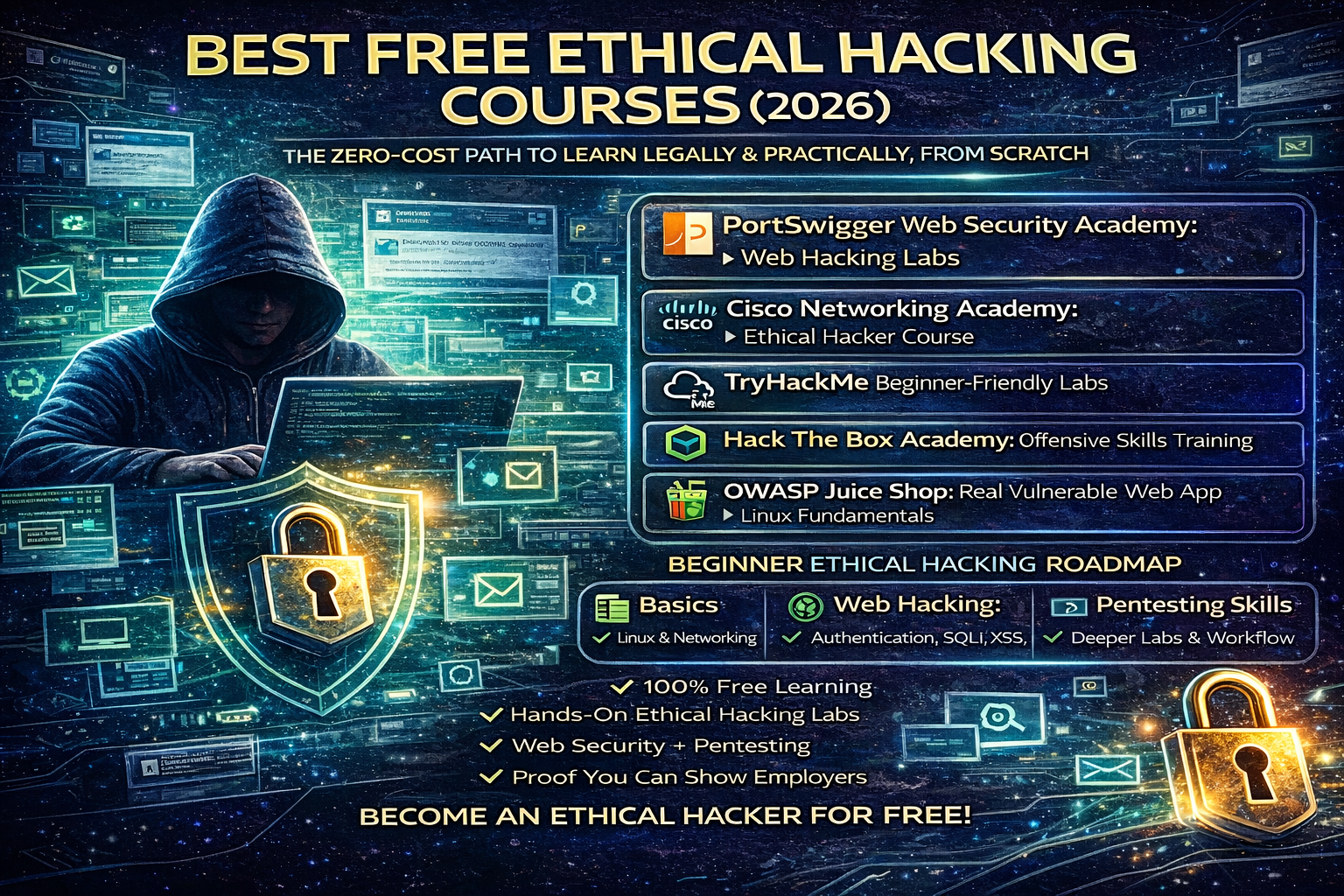
1) PortSwigger Web Security Academy (FREE) — Best for Web Hacking Skills
If you want the strongest free web-security learning on the internet, start here. It’s built by the team behind Burp Suite and includes guided labs on real vulnerabilities (SQLi, XSS, access control, authentication, SSRF, etc.).
What you’ll gain
- Web vulnerability thinking (why it happens)
- How to test in a legal lab environment
- How to explain impact + prevention (like a pro)
Best for
- Beginners → intermediate
- Anyone aiming at web pentesting or bug bounty foundations
2) Cisco Networking Academy Ethical Hacker (FREE) — Best “course-style” ethical hacking structure
This is a structured course designed to build offensive security skills in a proper learning flow and is listed as free in the catalog.
What you’ll gain
- A guided curriculum feel (good for disciplined learners)
- Broader offensive security topics in a “classroom” style
Best for
- People who like structured courses over scattered resources
- Learners who want a recognized training brand behind the content
3) TryHackMe (Free content) — Best for beginners who want hands-on guidance
TryHackMe has a strong collection of free beginner-friendly labs and also publishes guidance on free training options.
What you’ll gain
- Hands-on labs that teach fundamentals step-by-step
- Practical confidence: Linux basics, networking basics, simple enumeration mindset
Best for
- Absolute beginners who need a “follow this next” experience
- People who learn faster by practice than reading
4) Hack The Box Academy (Start for free) — Best for deeper pentesting skill building
Hack The Box Academy lets you start for free and offers interactive modules + structured skill/job paths.
What you’ll gain
- More realistic “pentest mindset” progression
- Strong technical depth once you have basics
Best for
- Learners who are past total beginner stage
- Anyone building toward job-role paths (web pentester, etc.)
5) OWASP Juice Shop (FREE) — Best “real app” practice for web vulnerabilities
Juice Shop is an intentionally vulnerable web app designed for security training and practice in a safe environment.
What you’ll gain
- Realistic web app testing practice
- Portfolio-ready writeups (vulnerability → impact → fix)
Best for
- Web app learners who want practice that feels closer to real systems
6) OWASP WebGoat (FREE) — Best for guided vulnerability lessons
WebGoat teaches common web vulnerabilities through structured lessons (excellent for learning concepts and secure coding mindset).
7) OverTheWire Bandit (FREE) — Best for Linux fundamentals that hackers actually need
Linux comfort is a cheat code in ethical hacking. Bandit trains file permissions, SSH, command-line thinking, and problem-solving.
8) EC-Council Learning (Free options) — Good for entry-level theory with certificates
EC-Council publishes a list of free beginner cybersecurity courses (good for foundational learning and validation certificates).
The Best Free Ethical Hacking Learning Path (Follow This Order)
If you want maximum progress with minimum confusion, follow this exact sequence:
Phase 1: Fundamentals first (7–14 days)
Goal: Understand what you’re attacking and defending.
Do:
- OverTheWire Bandit (Linux basics)
- TryHackMe beginner/pre-security style content
You should be able to explain
- DNS vs HTTP vs HTTPS
- Cookies + sessions (why they matter)
- Basic Linux permissions (why misconfigs break security)
Phase 2: Web hacking core (2–6 weeks)
Goal: Build the most in-demand skills: web app pentesting basics.
Do:
- PortSwigger Web Security Academy modules + labs
- OWASP Juice Shop practice
Rule that makes you “advanced faster”
For every vulnerability, write a mini professional note:
- What it is
- Where it appears (patterns)
- How to test (in a lab)
- Impact (real consequences)
- Fix (developer-friendly)
- Prevention checklist
That habit is what makes your blog posts rank better too—because you’re writing like someone who understands cause → exploit path → mitigation.
Phase 3: Pentesting workflow + depth (ongoing)
Goal: Learn structured methodology, not random tricks.
Do:
- Hack The Box Academy modules/paths (start free)
- TryHackMe “Offensive Pentesting” style progression when ready
About The Author